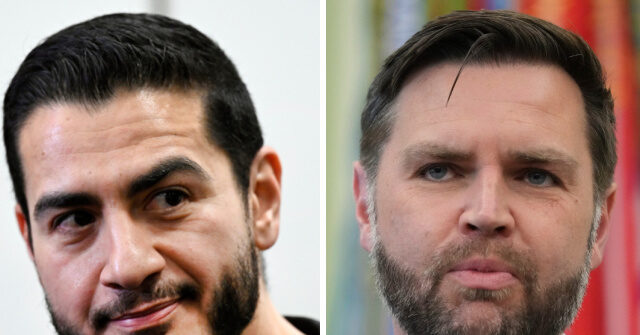
MI Senate Candidate Abdul El-Sayed Won’t Apologize for Vile Remarks on JD Vance’s Wife & Children: I Did It ‘out of Love’
An Egyptian-American Muslim who is running for Michigan’s open Senate seat says he has “profound animus” towards Vice President JD Vance for seeking to preserve Americans’ unique culture amid a flood of diverse migrants.
“I have a profound animus for somebody who is going to bend moral arguments in his favor to aggrandize himself,” Abdul El-Sayed told a podcaster.
His judgment came after he claimed that Vance’s recognition of a unique American culture contradicts his marriage to his Indian-heritage wife and the future of his American children. He claimed:
It’s an odd thing to be an American Vice President who has made the argument that some people are more American than others, when your own family would not fit in the group that you call [more] American … It is a profound level of hypocrisy to want to build an America where your own kin do not belong the same way as others, and then not to actually talk about it.
But El-Sayad’s caricature criticism of Vance ends up validating Vance’s comments, even as it also helps El-Sayad gain ground in the diverse Democrat Party politics in Michigan.
His caricature validates Vance’s argument because it exposes the aggressive nature of El-Sayad’s political ambition in a nation where the imported Islam of his supporters in the immigrant Muslim community is inflexible and incompatible with Americans’ tolerant, free-speaking, and open culture.
“I look at my kids every day, and so much of what I do is about trying to create an America where those kids are just as American as everyone else,” El-Sayad said, as if the Egyptian-origin Islam that surrounds his children should be deemed as mainstream as the Christianity that has guided Americans’ culture since the first colonists.
“I want them to believe they’re just as American as anyone else …. I’m as American as you can get,” El-Sayad said without acknowledging the vast distance between Islam and ordinary American life.
Any attempt to ensure status equality for Islam and its adherents would require fundamental civic concessions from hundreds of millions of Americans who viscerally disagree with Islam’s goal of imposing an Earthly Islamic utopia that is devoid of democracy, personal freedoms, religious equality, or respect and rights for girls, wives, women, and non-Muslims.
El-Sayad’s vision of an American also includes minimal enforcement of the nation’s popular immigration laws. He has repeatedly urged the abolition of ICE, which would massively increase costly and chaotically diverse migration from diverse countries — including his father’s homeland, Egypt.
El-Sayed is hiding these conflicts behind his call for more government-provided healthcare and other benefits, denouncing “racism,” and downplaying his favored immigration policy, which gets minimal space on his campaign website.
Vance, on the other hand, is carefully trying to preserve a society where ordinary Americans’ culture and families can prosper — while also providing decent respect and freedoms for the diverse, incompatible, premodern, and minority cultures that are being imported by the nation’s economic policy of mass immigration.
Vance is Catholic and outlined his political task in a 2025 speech at the Claremont Institute 2025, prompting bitter criticism from progressives and other pro-migration advocates.
“While our elites tell us that diversity is our greatest strength, they destroy the very institutions that allow us to thrive and build a common sense of purpose and meaning as Americans,” he told his audience, adding:
While our elites tell us that diversity is our greatest strength, they destroy the very institutions that allow us to thrive and build a common sense of purpose and meaning as Americans. We are confronted with a society that has less in common than ever, and whose cultural leaders seem totally uninterested in fixing that …
If you think about it, identifying America just with agreeing with the principles, let’s say, of the Declaration of Independence, that’s a definition that is way overinclusive and underinclusive at the same time.
What do I mean by that? Well, first of all, it would include hundreds of millions—maybe billions—of foreign citizens who agree with the principles of the Declaration of Independence. Must we admit all of them tomorrow? If you follow that logic of America as a purely creedal nation—America purely as an idea—that is where it would lead you.
But at the same time, that answer would also reject a lot of people that the ADL would label as domestic extremists, even though those very Americans had their ancestors fight in the Revolutionary War and the Civil War … I think the people whose ancestors fought in the Civil War have a hell of a lot more claim over America than the people who say they don’t belong.
So I believe one of the most pressing problems for us to face as statesmen is to redefine the meaning of American citizenship in the 21st century. I think we got to do a better job at articulating exactly what that means. And I won’t pretend that I have a comprehensive answer for you, because I don’t.
“America is not just an idea — We’re a particular place with a particular people and a particular set of beliefs and way of life,” he said. “You cannot swap 10 million people from anywhere else in the world and expect for America to remain unchanged.”
Vance, who does not proclaim “profound animus” to his domestic political rivals — also explains how his family fits into that flexible vision:
I believe, and my own story is a testament to that, that yes, immigration can enrich the United States of America. My lovely wife is the daughter of immigrants to this country, and I am certainly better off—and I believe our whole country is better off—for it. But we should expect everyone in our country—whether their ancestors were here before the Revolutionary War or whether they arrived on our shores just a few short months ago—to feel a sense of gratitude. And we should be skeptical of anyone who lacks it—especially if they purport to lead this great country.
On the campaign trail, Al-Sayed downplays the cultural clash caused by his Islamic-infused ambitions, and also keeps his scarf-wearing wife on a low profile — even as he pleases his progressive supporters by sneering at Vance for supposed hypocrisy.
It is a profound level of hypocrisy to want to build an America where your own kin do not belong the same way as others, and then not to actually talk about it. And so at least with me, you know, when I think about my kids, there is a linearity about I want an America where his kids, my kids, all of our kids, get to live without being told that they are less than and do not deserve … I made the point out of a love for his kids, frankly, right? Because I want them to believe they’re just as American as anyone else.
El-Sayed can rely on this two-track policy during the Democratic primaries, where he faces little or no media skepticism.
But in the general election, the political tensions generated by his Islamic-infused priorities in U.S. society will be compressed into many 30-second attack ads for display to many millions of ordinary decent Americans. His claims of contempt for Vance will not solve that political dilemma.
editor's pick
latest video

news via inbox
Nulla turp dis cursus. Integer liberos euismod pretium faucibua