This post was originally published on this site.
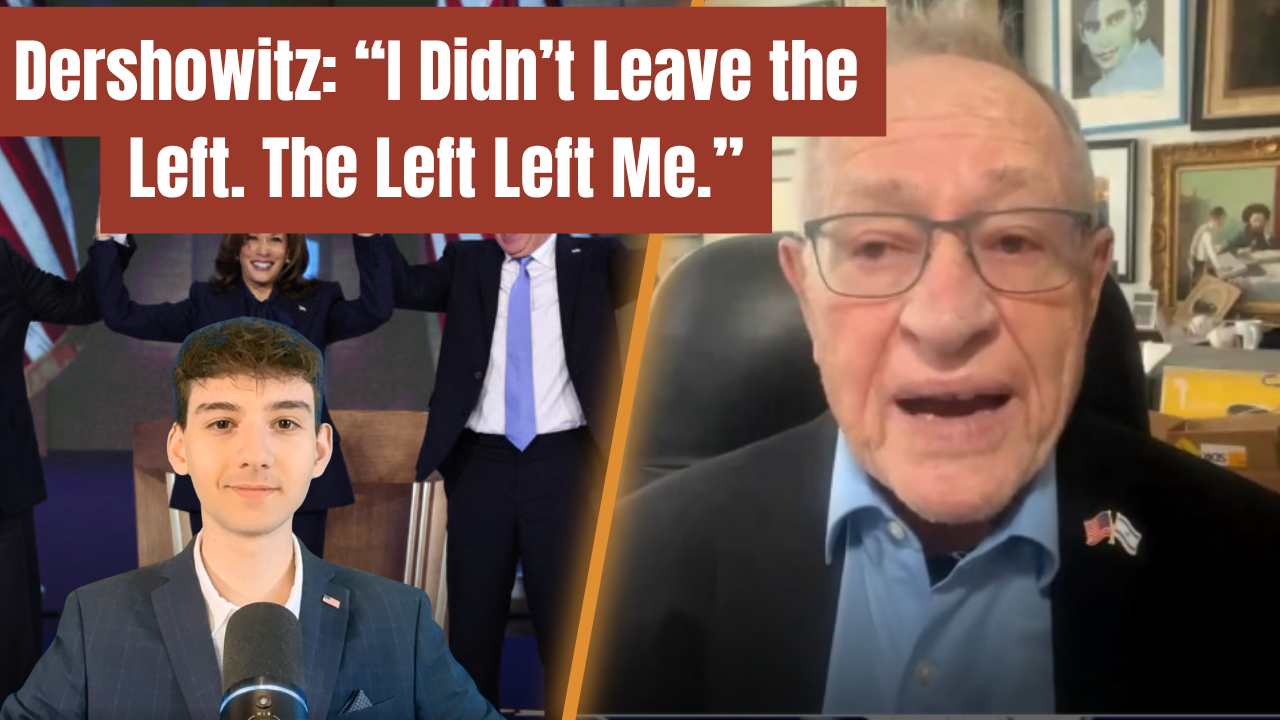
EXCLUSIVE INTERVIEW: Alan Dershowitz BLASTS the Left—“They Left Me,” Calls Out Radical Shift (VIDEO)
This post was originally published on this site.

WATCH: In Exclusive Interview, Alan Dershowitz Reveals Why He Broke with the Left
In an exclusive interview, Alan Dershowitz delivered a direct assessment of today’s political landscape, arguing that the modern Left has moved away from its long-standing commitment to open debate and reason—particularly on issues related to Israel.
“I didn’t leave the Left. The Left left me,” Dershowitz said, pointing to what he described as a sustained shift away from core liberal principles, including free speech, due process, and viewpoint tolerance.
Dershowitz, a lifelong Democrat who built his career defending constitutional protections and consistently supporting Israel’s right to exist and defend itself, identified Israel as one of the clearest fault lines in that shift.
Positions that were once considered mainstream within liberal circles—such as support for Israel’s security and opposition to antisemitism—now increasingly generate backlash in academic and political spaces.
The issue, as Dershowitz framed it, is not disagreement. Disagreement has always existed, including on foreign policy.
The problem is the growing refusal to allow certain positions, particularly pro-Israel perspectives, to be expressed without consequence.
That shift has had measurable consequences. Universities that once functioned as platforms for debate now regularly see speakers protested, disinvited, or shut down. Students who express support for Israel often face social and institutional pressure, creating an environment where certain viewpoints carry clear risks.
Media institutions, according to Dershowitz, reinforce that same pattern. Coverage of Israel-related issues increasingly reflects a narrow framework, limiting the range of perspectives presented to the public and discouraging deviation from dominant narratives.
Dershowitz contrasted that environment with what he sees emerging on the political right: a broader willingness to tolerate internal disagreement, including on Israel, foreign policy, and broader geopolitical strategy. That observation challenges the common narrative that the right operates with rigid ideological conformity.
In practice, conservative spaces include visible disagreements on issues such as U.S. involvement abroad, aid to Israel, and broader Middle East policy. Those debates are not suppressed; they are openly contested.
By comparison, Dershowitz argued, deviation from dominant positions on the Left—particularly on Israel—often results in professional and social consequences. That dynamic encourages self-censorship and narrows the range of ideas that are publicly discussed.
The result is a clear reduction in intellectual diversity.
Dershowitz emphasized that a functioning democracy depends on the ability to test ideas through open exchange.
When institutions discourage that process—especially on complex international issues like Israel—they weaken their ability to produce informed and effective policy.
A system that prioritizes ideological conformity over open debate produces weaker analysis. Positions that are not challenged are not strengthened.
Dershowitz’s comments reflect a broader trend. Individuals who once aligned with the Left are increasingly distancing themselves, not necessarily because their views on issues like Israel have changed, but because the acceptable range of views has narrowed.
The central divide in American political life is no longer defined solely by policy differences. It is increasingly defined by whether institutions are willing to tolerate dissent—especially on issues like Israel.
You may not agree with Dershowitz on every point he makes. No one agrees with every point made by any individual. What distinguishes the political right, however, is a greater tolerance for dissent and open debate. In many cases, that disagreement is encouraged.
By contrast, the Left increasingly relies on rhetoric, social pressure, and coordinated messaging to marginalize opposing views, while conservative activists respond by inviting direct debate.
The Patriot Perspective has recently switched its main platform from YouTube, and we would greatly appreciate it if you subscribed to us there. [HERE]
Have a question for the show? Like the video and comment your question, and we will be sure to answer it in our next episode’s letters segment. [HERE]
The post EXCLUSIVE INTERVIEW: Alan Dershowitz BLASTS the Left—“They Left Me,” Calls Out Radical Shift (VIDEO) appeared first on The Gateway Pundit.
editor's pick
latest video

news via inbox
Nulla turp dis cursus. Integer liberos euismod pretium faucibua
Leave A Comment
You must be logged in to post a comment.