This post was originally published on this site.
Burma War: Easter Celebration Delayed for Internally Displaced
This post was originally published on this site.


“God is so good to us,” said Ku Ro-beh, explaining how grateful he and the other inhabitants of the internally displaced persons (IDP) camp were to be able to hold even a modest Easter celebration without being killed. “We worried about airstrikes, but God protected us.”
This year, following the sham elections in which the military junta leader installed himself as the country’s new president, the Myanmar junta has continued its offensive, killing and displacing civilians across the country. Beyond losing loved ones and sometimes their limbs, civilians are forced to flee, adding to the more than 3.7 million people already displaced within the country. Fleeing to the jungle means farmers lose their fields, crops, and animals.
The World Food Programme warned that more than 12 million people in Myanmar will face acute hunger in 2026, with a projected one million reaching emergency levels requiring immediate assistance. More than 400,000 young children and mothers suffering from acute malnutrition are surviving on nutrient-deprived diets. Children lose access to education. For the religious, whether Buddhist or Christian, it often means losing access to temples, churches, and holy sites during times of observance.

Since Easter 2026, the junta has carried out airstrikes across multiple regions. On April 9, six people, including two children, were killed in an assault in Chin State. On April 13, the military conducted airstrikes and drone attacks in Kachin State. A wave of forced recruits sent to attack on foot was repulsed with heavy casualties. This marks another tragedy in the war: the forced recruitment of both males and females. In some cases, ethnic boys as young as twelve have been forced into the junta’s army and then tasked with killing their own people.
Also on April 13, airstrikes hit a monastery in Sagaing Region, killing two novice monks and injuring eight others, with no active fighting and no resistance forces present. A separate airstrike on a monastic school in Sagaing killed at least five people, including three novice monks, and injured nine others. The attacks involved jet fighters, Mi-35 combat helicopters, paramotors, drones, and Y-12 aircraft targeting civilians.
The following day, junta troops dumped the bodies of four civilians bearing signs of torture in Kachin State, and troops burned five villages in Mandalay Region in a single day. A military jet destroyed a building at Mutraw Junior College in Karen State, a school that had already relocated twice due to ongoing attacks. Airstrikes on resistance-held territory in Sagaing continued throughout the Thingyan holidays, the Burmese New Year, killing at least one civilian, a 14-year-old girl.
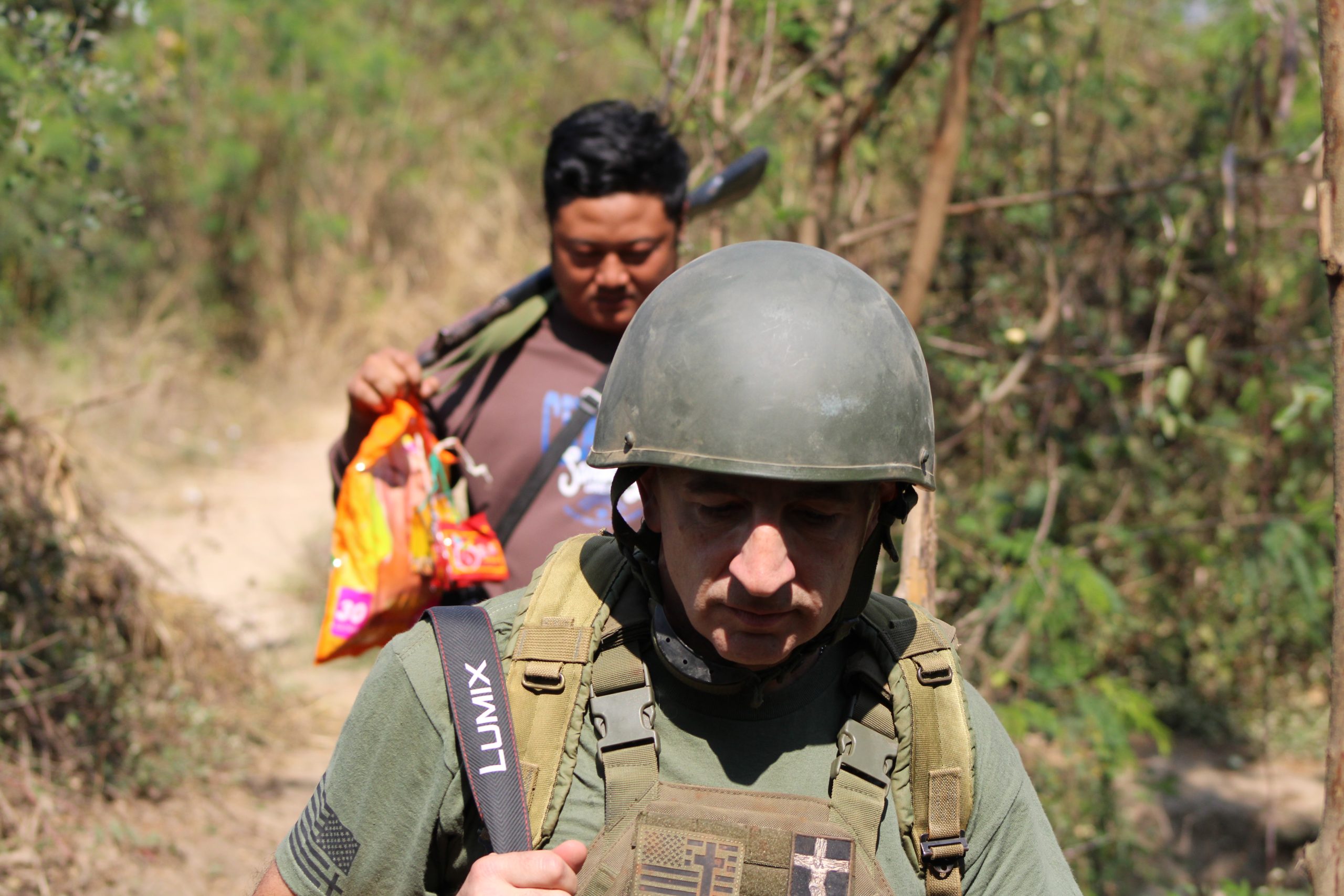
Amid the ongoing attacks on civilians across the country, residents of some IDP camps in Karenni State had to delay their Easter celebration until a priest was able to visit. The displaced Catholics are separated from their parishes, and each priest is now responsible for a large number of camps, forcing them to travel through the jungle from camp to camp to hold Mass at each one in turn.

Ku Ro-beh, who was displaced with his wife and children four years ago, works as an administrator in a large IDP camp with a population that peaked at around 9,000 people. He explained how, despite the threat of war and lack of resources, he and other community leaders organized an Easter celebration for the camp.
Just a few years ago, the church in the camp had been hit by an airstrike, and since then people have been careful not to gather in large crowds that could be seen from the air. Another challenge was timing. The Easter celebration had to be held a week late because the priest was tied up in other camps.
Because there is no way for displaced people to work, there is very little cash available in the camps. In fact, most camps do not even receive regular rations or aid distributions because both the UN and international NGOs refuse to provide aid inside the conflict zone. Instead, the camps depend on resistance governments, which have almost no tax revenue. They also receive a small amount of support either through family connections abroad or through the Church.
There used to be support from other parts of Burma, but those transfers are closely monitored and prohibited by the junta. A further problem is that after five years of civil war, there is severe donor fatigue, particularly as the economy in the rest of the country has steadily worsened. As a result, the small number of donors from other parts of Burma are themselves facing shortages of everything, including food.

Ku Ro-beh explained that some money was sent through private donations for the Easter celebration. “We prayed,” he said, and in the end they had about $800. “This is the most money we have ever had for a celebration.” The previous year, they managed a loaves-and-fishes miracle, hosting a Christmas dinner with a budget of $500. “The priest came and we had Mass.”
They also managed to purchase three pigs and two 20 kg baskets of fish. “But for security reasons, we did not make other plans like activities and songs.” They celebrated Mass and ate lunch together. Everyone in the camp was invited, and they wound up feeding about 500 people, about 300 of whom were Catholic, while the rest were Baptist, Buddhist, or animist.
“We all felt very happy,” said Ku Ro-beh. “This Easter celebration was very important for us because Easter is the most important day for Catholic Christians. For me, I feel God is always with us, even though we suffer this long war.” He concluded, “Listening to God’s words, joining the Mass, and trusting in Him comforted me greatly.”
The post Burma War: Easter Celebration Delayed for Internally Displaced appeared first on The Gateway Pundit.
editor's pick
latest video

news via inbox
Nulla turp dis cursus. Integer liberos euismod pretium faucibua
Leave A Comment
You must be logged in to post a comment.