This post was originally published on this site.
Who is Funding Fulani Militants Killing Christians in Nigeria?
This post was originally published on this site.

The Fulani militant campaign is the deadliest source of violence against Christians in the world. Of 36,056 civilian killings across Nigeria between 2019 and 2024, 47 percent were directly linked to Fulani militias, according to the Observatory for Religious Freedom in Africa. In states where attacks occur, Christians were murdered at a rate 5.2 times higher than Muslims relative to population size, with three Christians killed for every Muslim. Fulani militants were responsible for 55 percent of recorded Christian deaths between 2019 and 2023, nearly seven times the number killed by Boko Haram and ISWAP combined.
Kidnapping is also a primary funding mechanism. ORFA documented 29,180 civilians abducted between 2019 and 2024, with individual raids regularly exceeding 100 victims, including 287 students seized in a single attack in Kuriga, Kaduna State in March 2024 and more than 300 taken from St. Mary’s Catholic School in November 2025, the largest school kidnapping on record.
Nigeria’s National Bureau of Statistics found that Nigerians paid $1.42 billion in ransoms from May 2023 to April 2024 alone. Those payments helped finance the next round of attacks while forcing Christian families to liquidate farmland and other assets to secure the release of relatives. Victims and community leaders report that after attacks drove Christians from their villages, Fulani groups often occupied the abandoned land, reinforcing claims that territorial expansion is a key objective of the violence.
The kidnapping-for-ransom economy that now partly sustains Fulani militant operations is a later development, not the original funding source. Three streams capitalized the campaign before kidnapping became viable: wealthy Fulani cattle owners, northern political and military patronage, and cross-border jihadist networks.
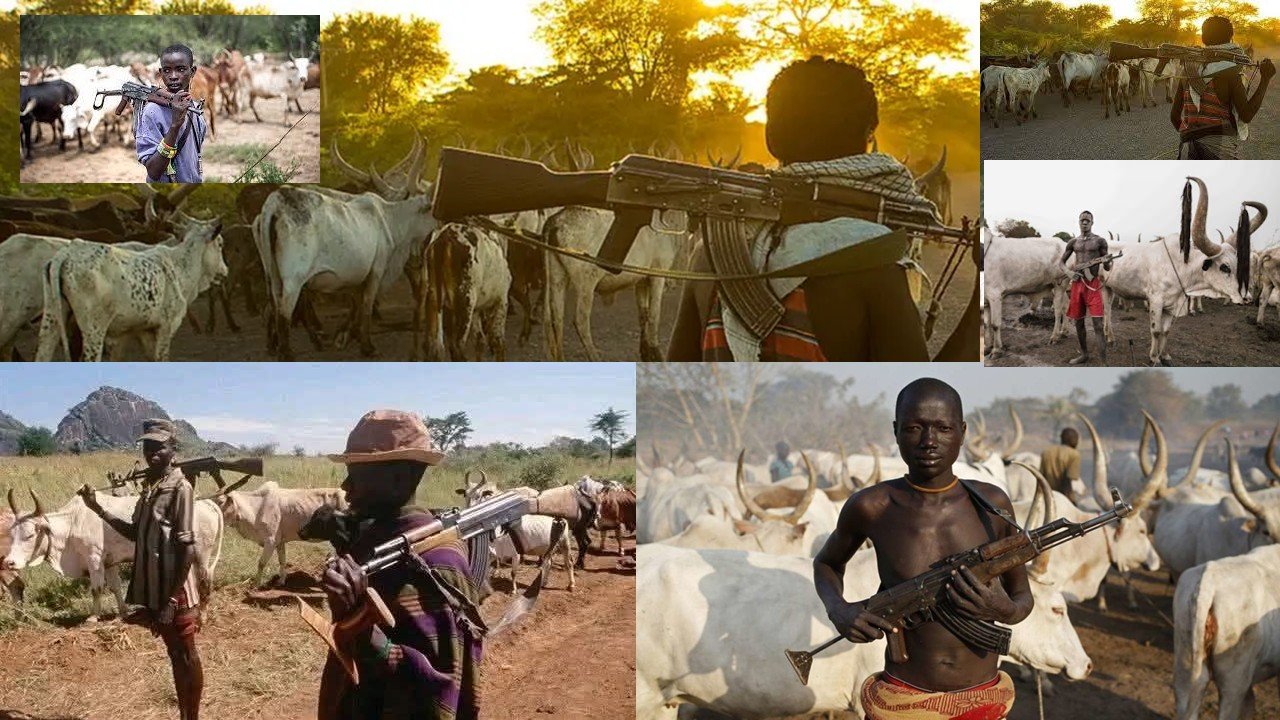
Since the 1980s, wealthy Fulani cattle owners have supplied fellow tribesmen with AK-47 assault rifles. Cattle profits are converted directly into weapons, while Christian communities surviving at a subsistence level often cannot afford firearms. Even when they can afford them, assault rifles are prohibited under Nigerian law, which is rigorously enforced against sedentary Christian farming communities while being largely ignored in the case of nomadic Fulani herders.
A 2025 peer-reviewed study by Texas Southern University researchers states directly that Fulani militants’ access to sophisticated weapons “is not surprising because they are financially supported by cattle owners through Miyetti Allah Cattle Breeders Association of Nigeria (MACBAN),” the organization the study identifies as financing the transformation of fighters who once carried knives and bows into units deploying assault rifles and AK-47s.
MACBAN’s institutional reach extends to the highest levels of northern Nigeria’s Islamic establishment. Founded in 1979 with the support of the Sultan of Sokoto, the Emir of Zazzau, the Emir of Katsina, and the late Emir of Kano, the organization counts former President Buhari, the son of a Fulani chieftain and a retired army major general, as its life patron.
Buhari publicly declared that Fulani herdsmen “carry sticks and not dangerous weapons,” a position that Amnesty International’s Nigeria Director said created a permission structure that guaranteed impunity. The foreign-fighter dimension further complicates the picture. The chairman of Oyo State’s Amotekun Security Corps warned federal agencies that infiltrators within Fulani militant networks included nationals of Mali, Guinea, Chad, and other West African countries, yet federal authorities took no action.
In 2025, a U.S. House resolution named MACBAN and its affiliate, Miyetti Allah Kautal Hore, and called for both organizations to be designated as Entities of Particular Concern.
The weapons financing documented through MACBAN and the cattle economy underwrites a territorial campaign whose scope is now measurable. An Intersociety investigation published on June 2, 2025, documented at least 950 locations across 770 to 800 of the South East’s 1,940 Igbo communities as being under occupation or threat of attack by armed Fulani jihadists and allied forces. According to the report, this represents approximately 40 percent of all communities in the region.
The trend is rising. Intersociety recorded 10 jihadist locations in January 2015. That number rose to 139 by August 2019, 350 by early 2020, 700 by April 2021, and 950 by June 2025. The state-by-state breakdown listed Enugu with 250 locations across 90 communities, Imo with 230 locations across 300 communities, Abia with 180 locations across 260 communities, Anambra with 160 locations across 70 communities, and Ebonyi with 130 locations across 50 communities.
The federal government’s own figures confirm the scale of the infrastructure supporting this expansion. Nigeria’s Minister of Livestock Development Idi Mukhtar Maiha announced at the National Council on Livestock Development in November 2025 that the government intends to rehabilitate 417 grazing reserves into what he called “Renewed Hope Livestock Villages,” a plan Intersociety identifies as cover for jihadist settlement programs operating through RUGA, the National Waterway Control Policy, the National Livestock Transformation Plan, Nigerian Military Livestock Ranching, FADAMA, and Federal Grazing Route and Reserve Mapping.
The mechanism by which these programs dispossess Christian communities is grounded in Nigerian law. Under Section 28(2) of the Land Use Act of 1978, all land in each state is vested in the state governor, who has the authority to revoke existing rights of occupancy for “overriding public interest” and issue Certificates of Occupancy, valid for up to 99 years, to new holders. Once a governor designates Christian communal farmland as a grazing reserve or livestock-settlement zone, the land is transferred out of community ownership, a Certificate of Occupancy is issued to the new holder, and the farming families lose both their land and their livelihood, often with little practical means of challenging the decision.
The seizures are documented at the community level. In Abia State, the traditional ruler and community leaders of Okahia in Obingwa Local Government reported in a May 2025 Pulse.ng report that herdsmen had acquired more than 5,000 plots in strategic border communities, including Mgboko Umuanunu near the Akwa Ibom border and Akpaa Mbato behind the National Institute for Nigerian Languages in Aba. According to the community leaders, petitions to the state government were ignored.
Intersociety alleges that the five South-East Christian governors entered an office-tenure securement deal with the Northern Sultanate, under which electoral and court victories were guaranteed in exchange for facilitating Fulani settlements and issuing Certificates of Occupancy to Fulani patrons. As evidence, the organization points to election challenges that were ultimately dismissed by the courts. Premium Times, Punch, and Vanguard confirm that petitions challenging Governor Alex Otti’s election were rejected by both the tribunal and the Appeal Court, which affirmed his victory.
Whether those rulings formed part of a broader arrangement tied to Fulani settlement expansion remains Intersociety’s allegation. However, reports of land transfers involving herdsmen are not limited to Abia State. In Imo State, leaders of the Umuapu and Obitti communities in Ohaji-Egbema told Daily Post in April 2025 that government officials, accompanied by security personnel, physically entered their farmlands to enforce land transfers, with armed herdsmen already occupying the area. Chief Chinaza Ajukwara of Obitti-Ohaji stated that the occupying herdsmen were armed and “ready to kill anyone on sight,” leaving the community in “perpetual panic.”
The land arithmetic makes a grazing rationale difficult to reconcile with the available geography. The South East’s five states occupy 29,525 square kilometres, while Niger State alone covers 76,363 square kilometres, more than 2.5 times the size of the entire Christian South East. The Intersociety report argues that Niger State alone could accommodate all of Nigeria’s cattle. Of Nigeria’s total landmass of 923,952 square kilometres, 78 percent lies in the North, while the South East contains barely 3 percent. The RUGA program specifies a minimum settlement size of 310 square kilometres, meaning fewer than 100 RUGA settlements could theoretically consume the entirety of the South East.
The cattle economy functions not only as a funding source but also as a money-laundering vehicle. Nigeria’s Financial Intelligence Unit (NFIU) documented a confirmed case in which two individuals used a cattle business as cover for illegal arms trading linked to terrorist financing. Monitored communications led to their arrest and subsequent UN Security Council sanctions for supporting Boko Haram.
Cryptocurrency has emerged as a parallel channel. In 2020, the UAE convicted six Nigerians of funneling more than $780,000 to Boko Haram through cryptocurrency. In a separate ISIS-linked case disclosed to Nigeria’s NFIU by a foreign financial-intelligence unit, two Nigerians received $19,900 and $9,900 in structured transfers designed to remain below reporting thresholds.
Nigeria’s peer-to-peer cryptocurrency market processed $59 billion in trades between July 2023 and June 2024, much of it outside traditional Know Your Customer controls.
The problem was compounded by Nigeria’s 2021 banking crackdown on cryptocurrency, which pushed transactions onto peer-to-peer platforms and made financial flows more difficult to monitor. In 2024, regulators froze more than 1,100 bank accounts linked to terrorist financing.
Beyond cattle and cryptocurrency, the NFIU identified a network in which a point-of-sale agent was connected to a terrorist leader. At a broader level, real estate and bogus consultancy firms have also been identified as money-laundering vehicles. Reflecting these vulnerabilities, Nigeria scored 7 out of 10 for financial-crime prevalence on the 2023 Global Organized Crime Index.
All of this operates within a system internationally recognized as structurally deficient. As of November 2024, Nigeria remained under FATF enhanced follow-up for anti-money-laundering and counter-terrorism-financing deficiencies identified in its 2021 Mutual Evaluation Report. Nigeria’s suspicious-transaction reporting system combines terrorism-financing reports with routine anti-money-laundering filings, potentially obscuring the most critical intelligence. At the same time, 41.6 percent of Nigerian adults remain outside the formal banking system, making cash and informal transfers the default not only for much of the population but also for the militant networks operating within it.
The post Who is Funding Fulani Militants Killing Christians in Nigeria? appeared first on The Gateway Pundit.
editor's pick
latest video

news via inbox
Nulla turp dis cursus. Integer liberos euismod pretium faucibua