Trump Threatens Expanded ‘Project Freedom Plus’ in Hormuz if Iran Rejects Deal
President Donald Trump warned Friday that the U.S. could revive and significantly expand “Project Freedom” in the Strait of Hormuz if Tehran ultimately rejects the emerging framework agreement now under discussion, as Washington awaited what Trump said was an expected Iranian response amid renewed naval confrontations, ongoing blockade enforcement operations, and escalating threats from senior Iranian officials.
Speaking to reporters outside the White House before departing Friday evening for his golf club in Sterling, Virginia, Trump said the administration was still awaiting Tehran’s formal response to the proposed memorandum of understanding aimed at establishing a framework for broader negotiations over Iran’s nuclear program, sanctions relief, and the reopening of commercial shipping lanes through the Strait of Hormuz.
“I’m getting a letter supposedly tonight, so we’ll see how that goes,” Trump said.
Asked whether he believed Iran was deliberately dragging out the negotiations, Trump replied: “We’ll find out soon enough.”
Trump also warned that if negotiations collapse, Washington could revive and significantly expand Project Freedom — the U.S.-backed maritime initiative launched this week to help guide stranded commercial vessels through the Strait of Hormuz before being temporarily paused amid the ongoing negotiations.
“We’ll go a different route if everything doesn’t get signed up, buttoned up,” Trump said.
“I think Project Freedom is good, but I think we have other ways of doing it also,” he continued. “We may go back to Project Freedom if things don’t happen, but it’ll be Project Freedom Plus, meaning Project Freedom plus other things.”
Trump did not specify what the additional measures would entail, though he has repeatedly warned in recent days that military operations against Iran could intensify dramatically if Tehran rejects the proposed agreement.
The remarks came as tensions again flared in and around the Strait of Hormuz despite the fragile ceasefire brokered last month through Pakistani mediation.
U.S. Central Command announced Friday that American forces disabled two Iranian-flagged tankers — the M/T Sea Star III and M/T Sevda — after the vessels allegedly attempted to violate the ongoing U.S. naval blockade by entering Iranian ports along the Gulf of Oman.
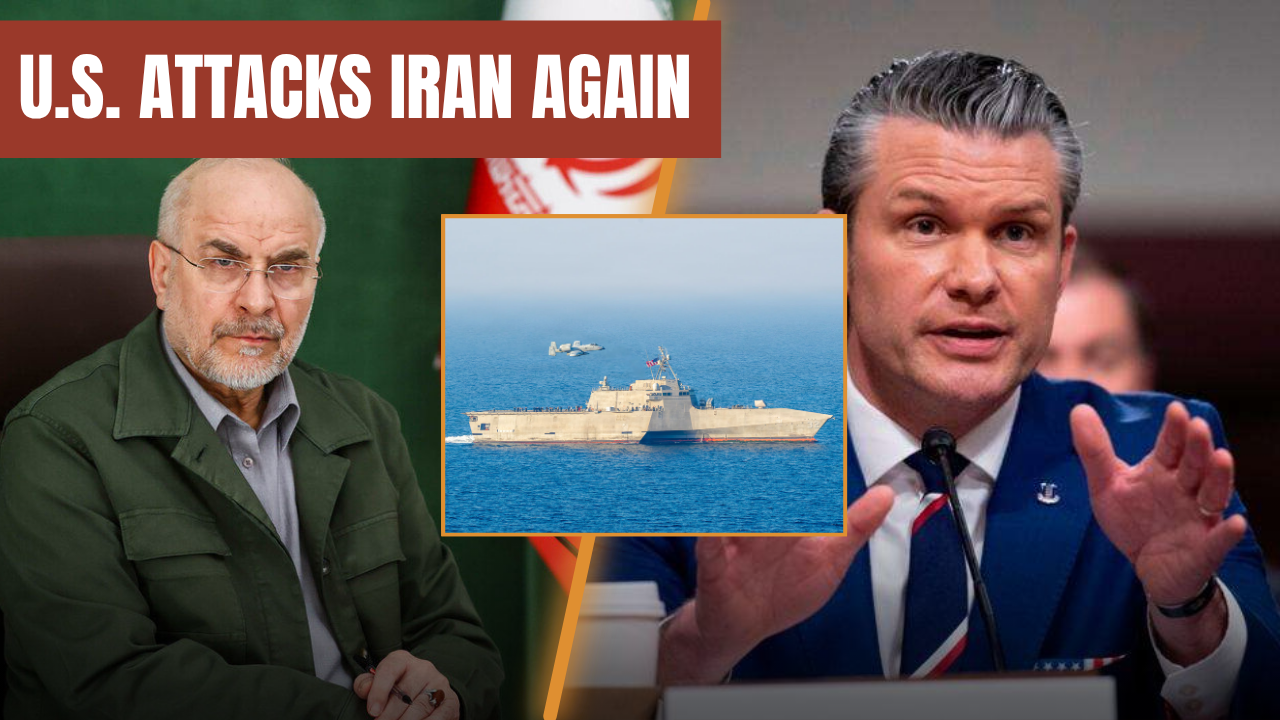
According to CENTCOM, a U.S. Navy F/A-18 Super Hornet launched from the USS George H.W. Bush fired precision munitions into the vessels’ smokestacks, rendering them inoperable before they could reach Iranian ports.
CENTCOM also confirmed Friday that U.S. forces this week disabled another Iranian-flagged tanker, the M/T Hasna, after it allegedly ignored warnings and attempted to breach the blockade.
“All three vessels are no longer transiting to Iran,” CENTCOM stated.
Adm. Brad Cooper, commander of U.S. Central Command, said American forces “remain committed to full enforcement of the blockade of vessels entering or leaving Iran.”
CENTCOM additionally released footage Friday showing American forces disabling the vessels and separately posted an image of a U.S. Air Force F-16 operating over the Middle East, stating U.S. forces in the region remain “mission ready.”
The latest developments came one day after Iranian forces attacked three U.S. Navy destroyers transiting the Strait of Hormuz toward the Gulf of Oman, prompting retaliatory U.S. “self-defense strikes” on Iranian military facilities and naval infrastructure.
CENTCOM said the USS Truxtun, USS Rafael Peralta, and USS Mason came under what it described as “unprovoked Iranian attacks” before U.S. forces “eliminated inbound threats” and struck Iranian missile launch positions, drone sites, command-and-control facilities, and intelligence infrastructure responsible for the assault.
Trump later elaborated on the confrontation in a Truth Social post, declaring that Iranian attacking forces had been “completely destroyed” after the destroyers successfully transited the strait “under fire.”
“There was no damage done to the three Destroyers, but great damage done to the Iranian attackers,” Trump wrote.
“These boats went to the bottom of the Sea, quickly and efficiently,” he added, while also writing that Iranian drones targeting the vessels “dropped ever so beautifully down to the Ocean, very much like a butterfly dropping to its grave!”
Earlier Thursday evening, Trump downplayed the retaliatory strikes as “just a love tap” while insisting the ceasefire remained in effect.
At the same time, however, Trump warned that if Iran ultimately refuses to finalize an agreement, military operations would escalate sharply.
“If they don’t agree, the bombing starts, and it will be, sadly, at a much higher level and intensity than it was before,” Trump warned earlier this week.
Trump also reiterated Thursday that any agreement would require Tehran to permanently abandon nuclear weapons ambitions and transfer its highly enriched uranium stockpile — which he has repeatedly referred to as “nuclear dust” — to the United States.
“We’re not going to give them the right to have a nuclear weapon,” Trump said Thursday. “Zero chance, and they know that.”
The administration’s proposed framework agreement — widely described in multiple reports as a one-page memorandum of understanding — is expected to serve as the foundation for broader negotiations covering Iran’s nuclear program, sanctions relief, and maritime security arrangements in the Strait of Hormuz.
Trump announced Tuesday that Project Freedom would be temporarily paused at the request of Pakistan and other regional countries while negotiations continued, though he stressed the broader U.S. naval blockade around Iranian ports would remain “in full force and effect.”
The operation had initially been launched on Sunday after Trump announced that countries around the world had requested American assistance to help stranded commercial vessels safely transit the strategic waterway after months of Iranian attacks, threats, mining operations, and de facto blockade conditions.
Under the operation, U.S. Central Command deployed guided-missile destroyers, more than 100 aircraft, unmanned systems, and approximately 15,000 service members to support commercial transit through the strait while continuing enforcement operations against Iranian maritime traffic.
Iranian officials, meanwhile, continued publicly mocking Washington while delaying a formal response to the proposal.
Iranian Foreign Minister Abbas Araghchi — one of Tehran’s lead negotiators — accused the United States on Friday of repeatedly undermining diplomacy through military pressure.
“Every time a diplomatic solution is on the table, the U.S. opts for a reckless military adventure,” Araghchi wrote on X. “Whatever the causes, the outcome is the same: Iranians never bow to pressure.”
Iranian Foreign Ministry spokesman Esmaeil Baghaei separately mocked Trump’s warning Thursday that Tehran would see “one big glow” if the ceasefire collapsed and the conflict resumed at full intensity.
“It is a grotesque absurdity that they claim to seek peace and prevent a nuclear crisis, yet their proposed solution is ‘one big glow,’” Baghaei wrote Friday.
At the same time, senior Iranian officials continued escalating threats regarding the Strait of Hormuz itself.
Mohammad Mokhber, an adviser to Iran’s supreme leader, compared Iranian control over the strategic waterway to possessing an “atomic bomb,” while vowing Tehran would not “forfeit the gains of this war.”
“The Strait of Hormuz represents an opportunity as precious as an atomic bomb,” Mokhber said Friday.
The latest tensions underscored the increasingly fragile state of the ceasefire as Washington continued to await Tehran’s response to the proposal late Friday night.
Joshua Klein is a reporter for Breitbart News. Email him at jklein@breitbart.com. Follow him on Twitter @JoshuaKlein.
editor's pick
latest video

news via inbox
Nulla turp dis cursus. Integer liberos euismod pretium faucibua