This post was originally published on this site.
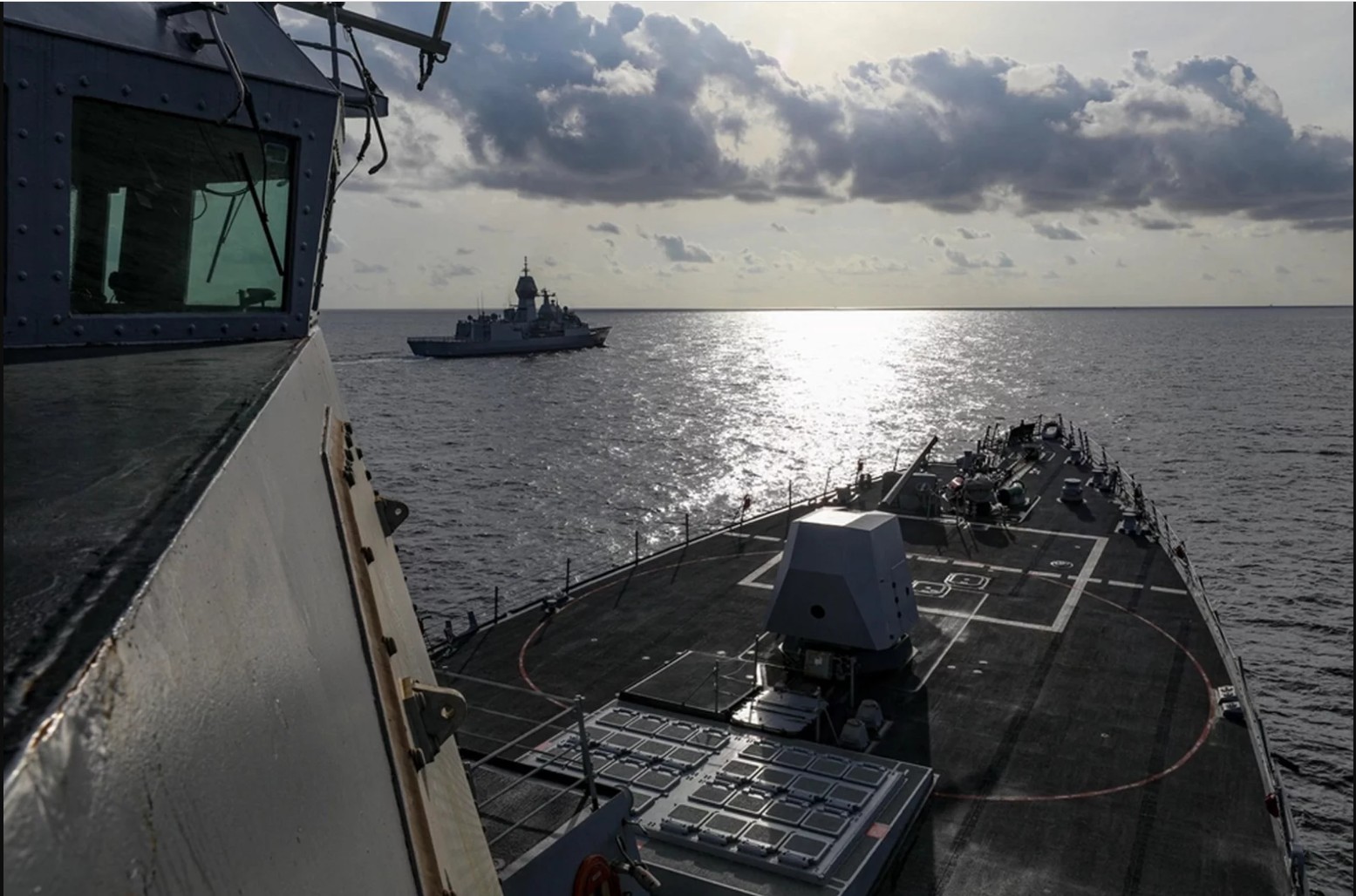
Thanks to Trump: The US Now Controls the World’s Major Oil Transit Chokepoints
This post was originally published on this site.

The world’s critical maritime chokepoints determine who controls the flow of oil, gas, and commerce between the Middle East, Europe, China, and the United States. The five most important chokepoints are the Strait of Hormuz, the Strait of Malacca, Bab el-Mandeb and the Suez Canal, the Strait of Gibraltar, and the Panama Canal. Together, they carry the overwhelming majority of the world’s seaborne energy trade, and within roughly fourteen months, the Trump administration has established or deepened U.S. military positioning at each of them.
The Strait of Hormuz is the single most important chokepoint, through which every barrel leaving the Persian Gulf passes. Saudi Arabia, Iraq, the UAE, Kuwait, and Iran all export through it, with no realistic overland alternative at comparable volume.
The Strait of Malacca is the primary route from the Middle East to China, Japan, and South Korea, carrying 80% of China’s energy imports, a dependency so acute that Hu Jintao coined the term “Malacca Dilemma” in 2003. Bab el-Mandeb and the Suez Canal function as a single linked system: all oil moving from the Gulf to Europe that does not go around Africa must pass through both.
The Strait of Gibraltar is the exit from the Mediterranean into the Atlantic, through which all Suez-routed oil heading to the U.S. East Coast or northern Europe must pass. The Panama Canal handles 5% of all maritime trade and 40% of all U.S. container ship traffic.
At the Panama Canal, a BlackRock-led consortium reached a $19 billion deal in early March 2025 to acquire CK Hutchison Holdings’ port operations on both ends of the canal, displacing Chinese-linked management. Defense Secretary Pete Hegseth signed a security cooperation agreement with Panama’s President José Raúl Mulino on April 9, 2025, and the first official U.S.-Panama Special Operations Forces talks were held on February 18, 2025, followed by joint training in marksmanship, demolition, and battlefield medicine.
China’s Ministry of Commerce announced it would oversee any port sale, and a definitive agreement had not been reached as of mid-2025, with Beijing pushing to include state-owned China COSCO Shipping in any transaction. Panama retains sovereignty and formal operational control under the Torrijos-Carter Treaties, but U.S. military and economic influence over the canal has increased substantially.
On February 28, 2026, U.S.-Israeli strikes under Operation Epic Fury hit more than 500 targets across Iran, including leadership bunkers, missile sites, and nuclear facilities, killing Supreme Leader Khamenei. Iran closed the Strait of Hormuz in retaliation, a waterway through which 25% of the world’s seaborne oil trade and 20% of global LNG had previously passed.
Following the failure of ceasefire talks in Islamabad, Trump announced a naval blockade of all ships transiting to or from Iranian ports beginning April 13, creating what analysts describe as a dual blockade. The U.S. Navy is blockading Iranian ports while Iran restricts Gulf passage. Defense Secretary Hegseth declared that “no one sails from the Strait of Hormuz to anywhere in the world without the permission of the United States Navy,” and confirmed the blockade had gone global, with two Iranian dark-fleet vessels seized in the Indo-Pacific. As of late April, the blockade had redirected 33 ships and boarded three vessels.
The blockade has cut an estimated $150 million per day in Iranian oil revenue, eliminated China’s access to discounted Iranian crude, and rendered unenforceable Iran’s parliament-codified transit toll scheme, under which payments were accepted in Chinese yuan routed through Kunlun Bank via CIPS, outside SWIFT, as a vehicle for RMB internationalization.
The Defense Intelligence Agency has told Congress that Iran still retains thousands of missiles and one-way attack UAVs despite degradation, and Pentagon officials have said mine clearance could take six months after hostilities end. The strait remains contested.
The Strait of Malacca recorded over 94,000 vessel transits in 2024, with approximately half bound for China. In the first half of 2025, 23.2 million barrels of oil transited daily, representing 29% of total seaborne oil trade, with 48% of that volume destined for China.
On April 13, 2026, Hegseth hosted Indonesian Defense Minister Sjafrie Sjamsoeddin at the Pentagon, announcing a Major Defense Partnership covering military modernization, joint training, and advanced technology cooperation. The agreement gives American forces operational reach over the strait, with aircraft including the KC-46A Pegasus, P-8A Poseidon, RC-135 Rivet Joint, and B-1B Lancer able to patrol it at any time. Washington also pushed for blanket overflight rights over Indonesian airspace; Jakarta resisted, and the provision was dropped from the final statement, though Indonesian officials confirmed talks continue on a preliminary Letter of Intent targeting emergency operations and crisis response.
On the Singapore side, the U.S. cleared a sale of up to four P-8A Poseidon maritime patrol aircraft in January 2026, with associated torpedoes and advanced mission systems. Singapore already provides the U.S. Navy access to Changi Naval Base under a Strategic Framework Agreement.
China has no near-term alternative to Malacca. The China-Pakistan Economic Corridor remains incomplete after years of delays, cost overruns, and security problems in Balochistan. The China-Myanmar Economic Corridor, which would give China Indian Ocean access through Kyaukphyu port, is stalled by Myanmar’s civil war.
Trans-Central Asian routes through Kazakhstan and Russia lack the capacity to absorb any meaningful share of Malacca’s daily volume, and manufactured goods cannot move overland to Europe or Africa at competitive cost or scale regardless of pipeline completion.
China’s strategic and commercial crude reserves cover over 120 days of net imports, but that buffer is finite. Beijing’s “String of Pearls” port access agreements, Gwadar, Hambantota, and discussions in Myanmar and Tanzania represent a long-term hedge, not a present solution, as none are operational military bases. China’s response to the Hormuz crisis sharpened the stakes.
On April 7, China and Russia vetoed a UN Security Council resolution aimed at protecting commercial shipping in the Strait of Hormuz, with Beijing’s UN envoy Fu Cong arguing adoption would send the “wrong message,” a veto that served a concrete interest, as Iran had continued shipping crude to China after the war began, with at least 11.7 million barrels delivered since February 28. Beijing used its Security Council seat to shield the chokepoint where it enjoyed preferential access. Six days later, Washington signed the defense partnership with Indonesia, tightening its grip on the chokepoint where China has none.
On April 16, 2026, the U.S. and Morocco signed a 10-year defense cooperation roadmap during the 14th session of the Morocco-U.S. Defense Consultative Committee at the Pentagon, deepening American positioning at the Strait of Gibraltar. Spain and the U.K. control the northern shore of the strait, while Morocco holds the entire southern shore, a gap in Western surveillance coverage the agreement is designed to close. The roadmap integrates Morocco into the Link-16 encrypted tactical data network normally reserved for NATO members, giving the U.S. effective presence on both sides.
Bab el-Mandeb, the “Gate of Tears”, is a corridor barely 30 kilometers wide at its tightest point, through which roughly 12% of global maritime trade passes daily. It functions as a linked system with the Suez Canal: all oil moving from the Persian Gulf to Europe that does not go around Africa must pass through both. When Houthi attacks disrupted the Red Sea from late 2023, Suez Canal transits fell from 2,068 in November 2023 to about 877 in October 2024.
The U.S. anchor at this chokepoint is Camp Lemonnier in Djibouti, the only permanent U.S. military base in Africa, hosting AFRICOM’s Combined Joint Task Force-Horn of Africa with over 5,000 military and civilian personnel, supporting counterterrorism, drone operations, and crisis response across the Horn of Africa and Red Sea basin under a lease held since 2002.
The U.S. demonstrated willingness to use force here across two administrations. Operation Prosperity Guardian, launched December 2023, became the United States’ single longest naval engagement since World War II, yet container shipping through the strait still dropped 90% as major carriers rerouted around the Cape of Good Hope. Trump escalated with Operation Rough Rider from March 15, 2025, producing a ceasefire on May 6, 2025, under which the Houthis agreed to halt attacks on U.S. vessels in exchange for a halt to U.S. strikes.
The ceasefire held until the Iran war: on March 28, 2026, the Houthis launched a ballistic missile at Israel and later warned that closure of Bab el-Mandeb was “likely” if the conflict escalated further.
China also operates a base in Djibouti, the PLA Support Base, its first and only official overseas military facility, built at a cost of $590 million and located adjacent to Camp Lemonnier near the Chinese-operated Port of Doraleh. However, the base is a support installation designed for logistics, resupply, and non-combatant evacuation, not a combat force. It has no carrier strike group and no independent power projection capability beyond its perimeter.
Any Chinese naval reinforcement dispatched from the mainland to Djibouti would have to travel either through the Strait of Malacca, where the U.S. is now positioned to interdict via the Indonesia MDCP and Singapore access, or around the western coast of Australia and across the Indian Ocean, where the U.S. Fifth Fleet and Diego Garcia form an interlocking logistics network China cannot replicate.
There is no route from China to Djibouti that does not pass through or near U.S.-influenced maritime space. In a conflict, China’s Djibouti base could be effectively isolated, making it a liability as much as an asset.
While the fighting in Iran and for the Strait of Hormuz continues, and the strait is not yet fully under U.S. control, the Trump administration’s coordinated positioning across Panama, Malacca, Gibraltar, and Bab el-Mandeb represents a strategic architecture that gives the U.S. significant leverage over much of the world’s oil supply.
The post Thanks to Trump: The US Now Controls the World’s Major Oil Transit Chokepoints appeared first on The Gateway Pundit.
editor's pick
latest video

news via inbox
Nulla turp dis cursus. Integer liberos euismod pretium faucibua
Leave A Comment
You must be logged in to post a comment.