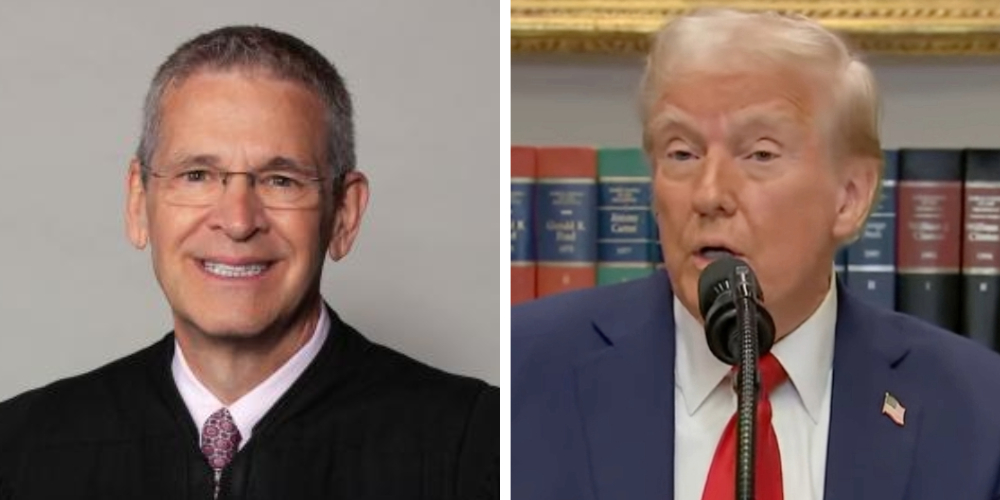
Rhode Island judge rules Trump admin is ‘anti-immigrant’ and bans block on asylum seekers from terrorist-harboring nations

A federal judge in Rhode Island has decided that he, and not the federal government, is responsible to decide who should enter the United States and under what circumstances. Judge John James McConnell Jr., against whom impeachment has been sought by Georgia Rep. Andrew Clyde, determined that the Department of Homeland Security is not permitted to pause asylum claims to the US.
McConnell claimed in his ruling that the plaintiffs, in this case non-profit groups Dorcas International, Refugee Dream Center, Service Employees International Union, International Union of United Automobile, Aerospace and Agricultural Implement Workers of America, African Communities Together, Venezuelan Association of Massachusetts, Partnership for the Advancement of New Americans and American Gateways, “have observed the legal processes that Congress enacted by statute and USCIS promulgated by regulation so that they may one day obtain immigration benefits.”
He complained that though the plaintiffs “have, for example, filed the appropriate paperwork, paid the required filing fees, submitted to this requested biometrics collection and attended the necessary in person interview,” they are now “stuck waiting, for months on end, for benefit requests that USCIS refuses to adjudicate.”
In other words, those seeking entry into the United States are entitled to it and cannot be denied. McConnell stated that the federal government’s immigration authority has “violated the very immigration laws that Congress has charged it with administering, as well as the administrative laws that govern the agency’s actions.”
“Local judge says it’s illegal to restrict migration and that America actually belongs to 8 billion foreigners—not you or your family and that no matter who you vote for you will be dispossessed. If SCOTUS doesn’t restrain these judges the people will lose all faith in the courts,” said White House aide Stephen Miller.
In making his ruling, McConnell claims that the administration’s policies “were motivated by anti-immigrant animus” and not by national security concerns. He worried that those already in the US would be thrown into “indeterminate legal limbo.” McConnell didn’t believe DHS of the Secretary of State’s assertions that those from these nations posed national security risks.
In June 2024, the Biden administration offered a sweeping mass amnesty to illegal immigrants, dismissing 77% of asylum cases without giving them either asylum or legal status. That resulted in hundreds of thousands of people who applied for asylum under Biden’s lax rules staying in the country without their cases being heard or assessed.
Biden had also changed the asylum rules, without Congressional approval, to allow asylum seekers to wait in the United States for their hearings, often years down the road. The administration claimed it was “prosecutorial discretion” to terminate the cases “without a decision on the merits.”
McConnell has taken it upon himself to determine both the national security risks posed by nationals from nations where terrorism is harbored, encouraged, and flourishing, and to create a new bias category that he believes the government has fallen prey to, “anti-immigrant animus.”
The Trump administration had sought to bar asylum claims from 39 countries. President Donald Trump issued a proclamation restricting entry from nationals of those nations and suspended the entry to the US of nationals from 19 countries.
The proclamation states that the US has an obligation to protect her citizens from foreigners “who intend to commit terrorist attacks, threaten our national security and public safety, incite hate crimes, or otherwise exploit the immigration laws for malevolent purposes.” The Immigration Nationality Act gives the president the authority “to suspend the entry of all aliens or any class of aliens” when the president “finds that the entry of any aliens or of any class of aliens into the United States would be detrimental to the interests of the United States.”
Those nations Trump wished to suspend from making asylum claims include Afghanistan, Burkina Faso, Burma, Chas, Republic of the Congo, Equatorial Guinea, Eritrea, Haiti, Iran, Laos, Libya, Mali, Niger, Sierra Leone, Somalia, South Sudan, Suda, Syria, Yemen, Angola, Antigua & Barbuda, Benin, Burundi, Cote d’Ivoire, Cuba, Dominica, Gabon, The Gambia, Malawi, Mauritania, Nigeria, Senegal, Tanzania, Togo, Tonga, Turkmenistan, Venezuela, Zambia and Zimbabwe. Many exceptions to the rules were included. Many of these are nations that harbor terrorists and have animus and hatred for the United States.
McConnell has ruled against the Trump administration repeatedly. Appointed by President Obama, McConnell has ruled against the Department of Agriculture’s plan to pause food benefits while Congress shut down the government, refusing to fund the programs. He ruled against Trump after the administration sought to revoke funds for public works projects in states that refused to follow federal immigration law.
In the impeachment resolution against him, he is accused of allowing “his personal, political opinions to influence his decisions and rulings.” In 2021, he spoke about the processing of sentencing, saying “When you’re sentencing someone that you have to take a moment and realize that this you know middle class, white, male privileged person needs to understand the human being who comes before us that may be a woman or may be black maybe be transgender maybe poor maybe rich maybe whatever may had experiences but not yours and may have to walk in their shoes and understand that the law applies to them where they are um and then you have to apply the law accordingly.”
Judge McConnell’s ruling against Trump asylum seeker limits by The Post Millennial
editor's pick
latest video

news via inbox
Nulla turp dis cursus. Integer liberos euismod pretium faucibua