This post was originally published on this site.
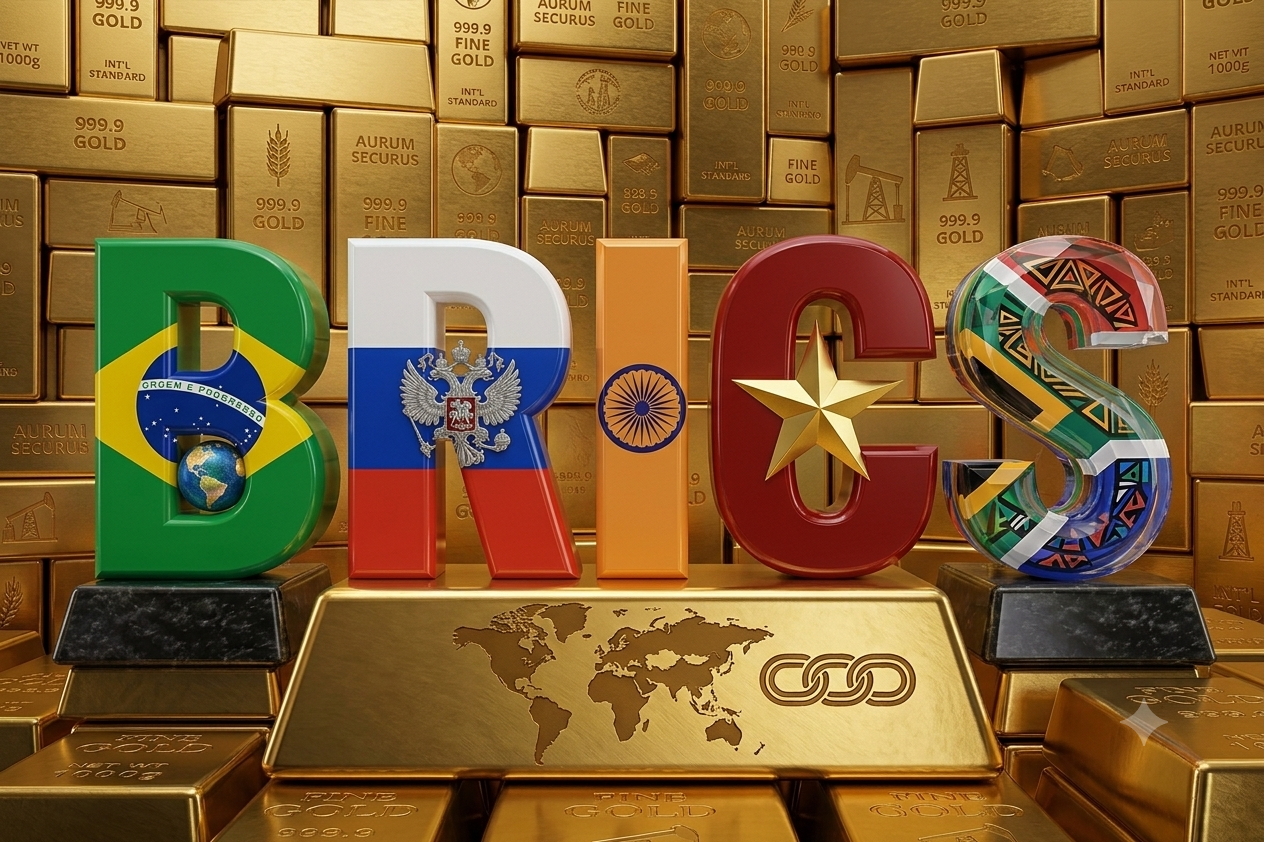
No, BRICS Are Not Hoarding Gold and Gold is Not Replacing the Dollar
This post was originally published on this site.

For some reason, humans have always been fascinated by gold. It is not because of gold’s utility. Copper, nickel, and rare-earth elements are all far more useful in manufacturing. In fact, rare-earth minerals are arguably among the most crucial resources in the modern economy. They have become so important that they have prompted major government policy initiatives in both the United States and China.
People often believe that the obsession with gold derives from its value. However, value alone cannot explain gold’s appeal, as several other minerals and metals periodically trade at higher prices, including rhodium, iridium, osmium, palladium, and ruthenium. Scarcity is another reason often given for gold’s appeal, yet all of these elements are rarer than gold.
A pervasive component of the folklore surrounding gold is the belief that, because the U.S. dollar is now a fiat currency, meaning it is not backed by gold, the world will eventually abandon the dollar and switch to another currency. However, all major currencies on Earth are fiat currencies, and the U.S. dollar was the last major gold-backed currency in human history.
A modern variation of the same fable holds that, because the dollar is a fiat currency, the world will eventually switch to a digital currency and the dollar will die. Yet digital currencies do not solve the fiat-currency issue. Central bank digital currencies are fiat currencies by definition, and most cryptocurrencies are not backed by gold or any other physical commodity. Simply changing the form of money from paper to digital does not eliminate the underlying reality of fiat currency.
The traditional story was that a foreign power would eventually develop a gold-backed currency that would displace the dollar and crash the U.S. economy.
This claim has surfaced repeatedly over the years. Adherents have made similar claims about Saddam Hussein and other foreign dictators after they were killed by the United States. Photos taken in the 1980s showing white men in military uniforms holding gold bars have been repeatedly circulated as alleged proof of U.S. troops stealing gold. The same images have been recycled every few years, with claims that they show gold being stolen from Ferdinand E. Marcos, Saddam Hussein, Muammar Gaddafi, and others.
The Gaddafi story has remained one of the most popular examples. Muammar Gaddafi is alleged to have been killed to prevent him from creating a pan-African gold-backed currency. While Gaddafi did publicly discuss the idea, no concrete steps were ever taken to implement it. No agreements were signed, he did not possess enough gold to back a currency for an entire continent, and no African nation was willing to surrender its sovereign currency. Also, Africa’s combined GDP is so small relative to the global economy that even if the continent rejected the dollar for internal trade, the impact on the dollar’s value would be minimal.
Yet the story persists as a cautionary tale in the realm of modern mythology, holding that merely suggesting the creation of a gold-backed currency to replace the dollar can result in death.
The latest iteration of the claim holds that a Chinese-led BRICS grouping will displace the dollar by creating its own currency. This prediction is then merged with the gold narrative into the assertion that BRICS will replace the dollar with a gold-backed currency.
The obvious problems with this theory are, first, that BRICS members are unwilling to surrender their sovereign currencies and, second, that there simply is not enough gold. All the gold ever mined, 216,265 tonnes as of year-end 2024, is worth roughly $29 trillion at current prices. Even including all known unmined reserves, the total reaches only about $47 trillion.
Global M2 money supply alone, the narrowest standard measure of the world’s money stock, is estimated at roughly $96 trillion, while broader global financial assets are measured in the hundreds of trillions of dollars.
No country holds anywhere near enough gold to back even its own currency, let alone a global one. The United States, which holds the world’s largest official gold reserves, values that stock at only about $1 trillion, a small fraction of U.S. M2 alone.
The BRICS argument, however, works better as a conspiracy theory than the Muammar Gaddafi theory did, because BRICS includes three of the world’s largest countries: China, India, and Russia. Additionally, the combined GDP of the BRICS countries far exceeds that of Libya under Gaddafi or Africa today.
Another point supporting the conspiracy theory is that China and Russia have historically held large amounts of gold in their reserves. Across the globe, the dollar accounts for more than half of all foreign-currency reserves, although most central banks also hold gold. Banks periodically buy or sell dollars and gold to rebalance their holdings.
One reason countries are reluctant to hold too much gold is that gold is not a currency. It is not being used as money and cannot be used efficiently to settle international trade. The mechanics of flying ounces of gold from country to country to settle trade, then weighing it and testing its purity for every transaction, make using gold as a currency logistically difficult and expensive. It must also be stored securely to preserve its value.
For all of these reasons, humans moved from commodity money, including gold and silver, to paper certificates and other forms of money hundreds of years ago.
Each time a BRICS member, usually China, Russia, or India, buys gold, claims surface on social media that BRICS is “hoarding gold,” supposedly in preparation for de-dollarization.
Of course, the primary problem with the de-dollarization argument is that there is currently no viable alternative to the U.S. dollar. As for “hoarding,” the term is subjective and emotionally charged, lacking a clear, quantifiable definition. These countries regularly purchase gold and hold it as part of their reserves, as they always have.
A recent data point that is not exactly false, but is misleading, is the claim that “BRICS bought half the world’s gold.” Russia and China together control about 74% of the bloc’s gold holdings, and the only meaningful buyers have been Russia, China, and India. In practice, “BRICS+ bought half the world’s gold” mostly refers to Russia and China buying gold, something they had been doing long before “BRICS+” became a political talking point.
Russia has been on a sustained gold-buying program since around 2014, following the Crimea sanctions, so its post-2022 purchases represent a continuation of an existing policy rather than a new pivot. China’s record is also discontinuous. The People’s Bank of China stopped publicly reporting gold purchases after May 2024, creating an 18-month gap that undercuts claims of an unbroken, coordinated, bloc-wide strategy.
Brazil made no gold purchases between 2021 and September 2025, a four-year absence during the supposed accumulation wave. South Africa, a founding member, also does not appear as a meaningful buyer, while newer members such as Ethiopia, Egypt, Iran, and Indonesia hold only minimal disclosed reserves. What is portrayed as a bloc-wide shift is, in reality, the actions of only a few members.
On the broader claim that BRICS is de-dollarizing or that gold is replacing the dollar, BRICS members have generally not been increasing gold’s share of their reserves, and most, Russia excepted, because of sanctions, still maintain the dollar as their principal reserve currency. China still holds more than $600 billion in U.S. Treasuries, and despite years of gold purchases, gold accounts for only about 6.8% of China’s total reserves. The UAE’s currency remains pegged to the dollar, and its reserves are held disproportionately in dollar-denominated assets.
Another claim feeding the gold-hoarding narrative is that BRICS countries have been repatriating gold held abroad. This is partially true, but it is not new. Russia has been steadily repatriating gold for more than a decade out of concern that the United States or Europe could freeze gold held in Western vaults. Some other BRICS members have done the same on a much smaller scale. Since this is gold they already owned, repatriation does not constitute hoarding, stockpiling, or “dumping the dollar.”
The bottom line is that the dollar remains the global currency, with no alternative in sight. It accounts for more than half of global trade settlement, including most trade between BRICS partners, roughly 60% of foreign-currency reserves, and more than 80% of foreign-exchange transactions. Gold is not a currency, is not used for trade settlement, and shows no sign of replacing the dollar. Nor is there any indication that BRICS is moving toward a common gold-backed currency.
If the Iranian regime and the IRGC end up falling as a result of the U.S.-Iran conflict, we can all look forward to the photos of soldiers holding gold bars resurfacing as the next conspiracy theory: that President Trump went to war with Iran to stop it from building a gold-backed currency to threaten the dollar.
The post No, BRICS Are Not Hoarding Gold and Gold is Not Replacing the Dollar appeared first on The Gateway Pundit.
editor's pick
latest video

news via inbox
Nulla turp dis cursus. Integer liberos euismod pretium faucibua