This post was originally published on this site.
Media Lies! No, Pritzker Did Not Just Balance the Illinois Budget
This post was originally published on this site.

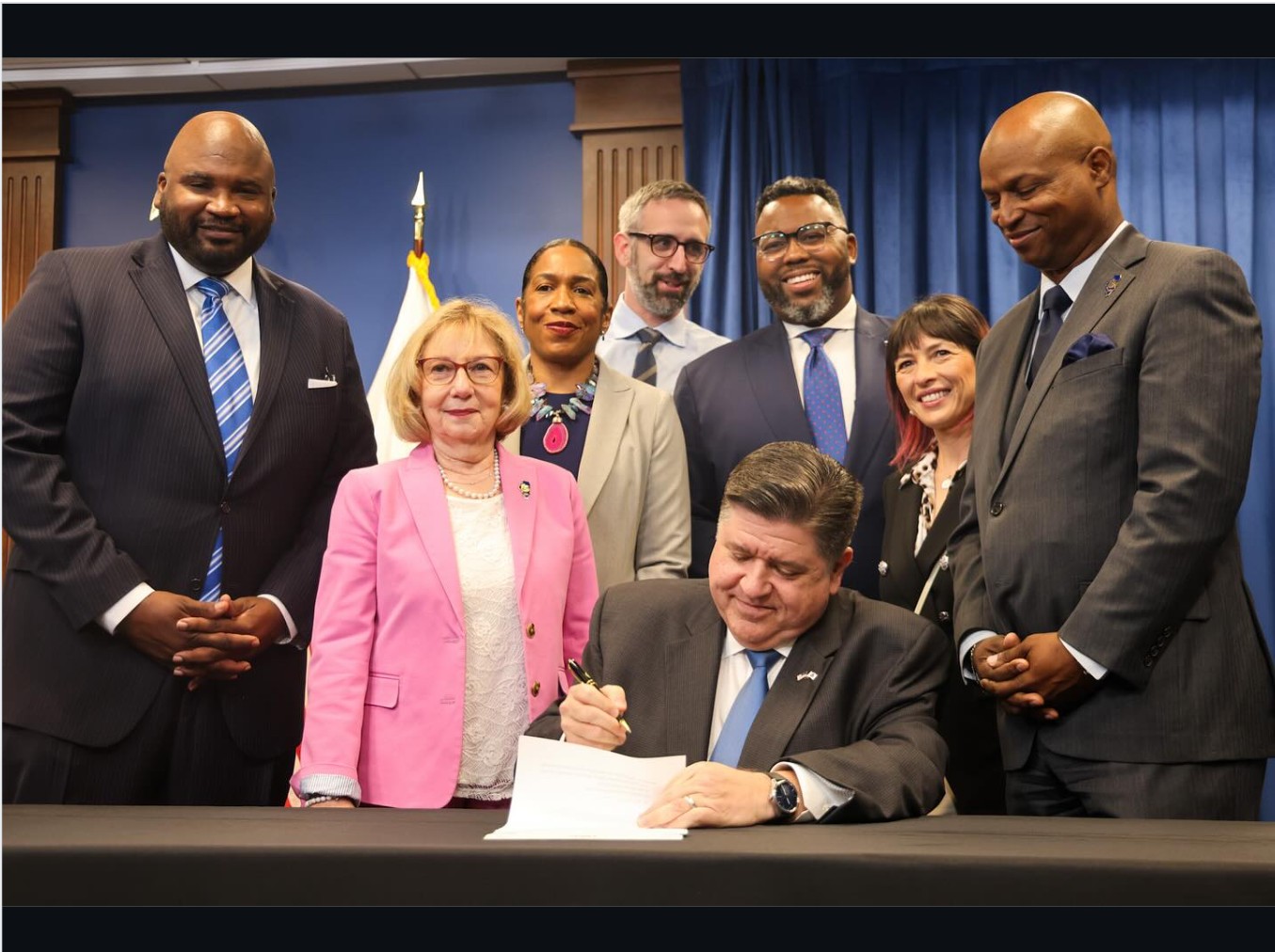
According to a press release from the office of the governor, the Illinois General Assembly passed Governor JB Pritzker’s eighth consecutive balanced budget, totaling $55.9 billion for Fiscal Year 2027. The plan focuses on making Illinois more affordable for working families, fully funding the state’s pension obligations, and investing in education, all while keeping discretionary spending increases below 1%.
Senate President Don Harmon (D-Oak Park) praised the budget, calling it a choice for “stability, responsibility and compassion” amid economic uncertainty and federal spending cuts. He said the plan supports working families, protects access to hospitals and health care, provides more than $300 million in new funding for public education, and includes a sales tax-free shopping holiday for parents, while avoiding increases in the state income tax or sales tax.
Similar to many Democratic spending claims, it includes terms such as “protects access to hospitals and health care.” Of course, no one was denying anyone access to hospitals. Hospitals are open, they remain open, and no one was being denied entry. Ostensibly, this is code for taxpayer-funded welfare programs continuing.
It is also telling that Democrats often refer to federal spending cuts as irresponsible. Just as Democrats become angry about the termination of temporary programs, such as the temporary free lunch program or temporary protections under DACA, once money has been spent or a particular policy has been put in place, they argue that it must continue indefinitely.
Pritzker claims that although he is reducing government revenue through tax cuts and increasing government spending through expanded social-benefit programs, he has produced a balanced budget. His office frames this as “fiscal discipline,” but a quick review of the state’s books shows that while he cut taxes in some areas, he increased them in others. The state continues to carry both massive debt and a deficit. Additionally, state pension contributions are structured under a ramp formula that underfunds what actuaries actually require.
A “balanced budget” in state government parlance means only that projected revenues equal projected expenditures for that fiscal year, an annual operating measure, not a gauge of overall fiscal health. Illinois is constitutionally required to pass a balanced budget each year, so the claim is partly definitional. It says nothing about accumulated obligations.
On revenue, the picture is mixed. Pritzker eliminated the 1% state grocery tax effective January 2026 and expanded a child tax credit, but simultaneously required $1.1 billion in new taxes in FY2025 through corporate tax changes, sports wagering levies, and limits on business loss deductions. The net effect has been higher overall revenue extraction.
General Funds revenues totaled $53.998 billion in FY2025, and the legislature’s nonpartisan Commission on Government Forecasting and Accountability (COGFA) projects FY2027 revenues at $55.5 billion, $550 million below the governor’s own estimate of $56.05 billion, a gap that is itself a point of dispute.
On spending, the state budget expanded from roughly $35.4 billion in FY2015 to $53.07 billion in FY2025 — a 30%-plus increase. The FY2027 proposal totals $56.03 billion, leaving a nominal surplus of just $24 million against the governor’s revenue estimate. Of that spending, roughly 64% is fixed or nondiscretionary, pensions, debt service, Medicaid, and education mandates, before lawmakers spend a dollar on discretionary programs.
The deficit picture depends on whose revenue numbers are used. Under the governor’s figures, FY2026 produces a surplus of $75 million. Under COGFA’s independent projections, the same budget produces a $673 million deficit.
Either way, the enacted FY2026 budget relies on $1.1 billion in one-time and manufactured revenue enhancements to sustain its funding levels, meaning the structural deficit persists regardless of which surplus figure is cited. Illinois’ own Governor’s Office of Management and Budget had earlier projected a $3.2 billion deficit for FY2026 before revenue revisions and legislative maneuvers narrowed it.
None of this touches the state’s actual debt. Illinois carries approximately $30 billion in outstanding bond debt, ranking fifth nationally. Far larger is the pension liability: unfunded pension debt stood at $143.5 billion at the end of FY2025, making Illinois the only state in the nation with over $100 billion in unfunded pension obligations.
Combined, total long-term obligations exceed $173 billion, a figure that does not appear on the “balanced budget” ledger. When state and local pension obligations are combined, Illinois leads the nation with nearly $16,000 per capita in unfunded pension liabilities, nearly double Connecticut, which ranks second.
The pension contributions Pritzker calls “full funding” are themselves structured under a ramp formula that falls approximately $5 billion short of what actuaries say is needed annually to prevent the debt from growing. The five pension systems already consume 20% of the state budget. A “balanced budget” in this context means revenues cover that year’s spending plan on paper. It does not mean the state’s finances are in order.
The post Media Lies! No, Pritzker Did Not Just Balance the Illinois Budget appeared first on The Gateway Pundit.
editor's pick
latest video

news via inbox
Nulla turp dis cursus. Integer liberos euismod pretium faucibua