
Israeli Troops Turn To Fishing Nets For Protection Against Hezbollah FPV Drones
For more than 2,000 years, fishermen in Israel’s Sea of Galilee were famous for using nets to catch St. Peter’s Fish, a form of tilapia with a biblical backstory. Now these anglers have gained new notoriety, helping keep some Israeli troops safe from Hezbollah first-person view (FPV) kamikaze drones. TWZ was among the first to highlight the danger these weapons have posed to Israeli forces in southern Lebanon and how the IDF was racing to install passive defenses, including nets, on its combat vehicles for protection.
The threat is so great and countermeasures so far limited, that some IDF troops are resorting to obtaining nets on their own from fishermen for protection, a senior IDF official confirmed to TWZ on Monday. The issue was first reported by Israel’s KAN public broadcasting network. This is in addition to netting the IDF itself is working to procure, which we will talk more about later in this story.
“Indeed, IDF soldiers are equipping themselves with fishing nets, most of which are being purchased in the city of Tiberias on the shores of the Sea of Galilee,” a senior IDF official told us. The troops are also buying nets from fishermen at Akko and Haifa on the Mediterranean, the official added.
“The drone threat has become a nightmare for the fighters on the ground,” the high-ranking official explained.
Fishing on the Sea of Galilee! Joshua Aaron / Rather Be in the Galilee
In our past reporting, we explained that the idea behind netting is that drones will get caught up in these barriers and become disabled, or, in some cases, the nets will help keep the drones far enough from the troops or equipment before exploding to keep personnel within the vehicles from being killed.
Israel, as we have previously noted, started using netting on vehicles and other equipment as the FPV threat grew.
You can see one example of this in the following video.
The use of nets as a defensive measure was first employed in Ukraine as FPV drones became the ubiquitous weapon of choice for both sides.
You can see an early example of Russians using netting in the video below.
In our initial stories about Hezbollah’s FPV arsenal, we noted that the Iranian-backed proxy group was adding a challenge to the IDF by increasing the percentage of FPV drones guided by fiber optic cables. These wires mitigate the effect of electronic warfare efforts to jam radio signals as well as some of the limitations imposed by geographical features that can impede the line-of-sight radio connection between drone and operator.
Videos of these attacks began to emerge online last month, which you can see below.
Now there’s a new problem for Israel to solve when it comes to FPV drones. Hezbollah has begun using thermal cameras on these munitions so they can be deployed in night attacks, the IDF official told us. Thermal cameras register heat signatures, turning them into thermal images using differences in temperature.
By adding thermal cameras to the FPV drone, Hezbollah “severely restricts [our] movement both during the day and at night,” he postulated.
Combined with fiber-optic guidance, the use of thermal cameras on FPV drones “creates an extraordinary level of deterrence against the forces operating inside Lebanon and along the border,” the senior IDF official bemoaned. “It is terrifying, dangerous, and frightening in equal measure.”
“The forces are essentially static,” the official added. “They cannot advance toward the drone-launch areas, nor can they effectively target the drone logistics and operational chain extending through the Beqaa Valley, Tyre, Sidon, and even Beirut.”
“Our operational doctrine must change,” he added. “We need to shift from completely exposed operations, where our soldiers become easy targets for Hezbollah, to covert and concealed activity.”
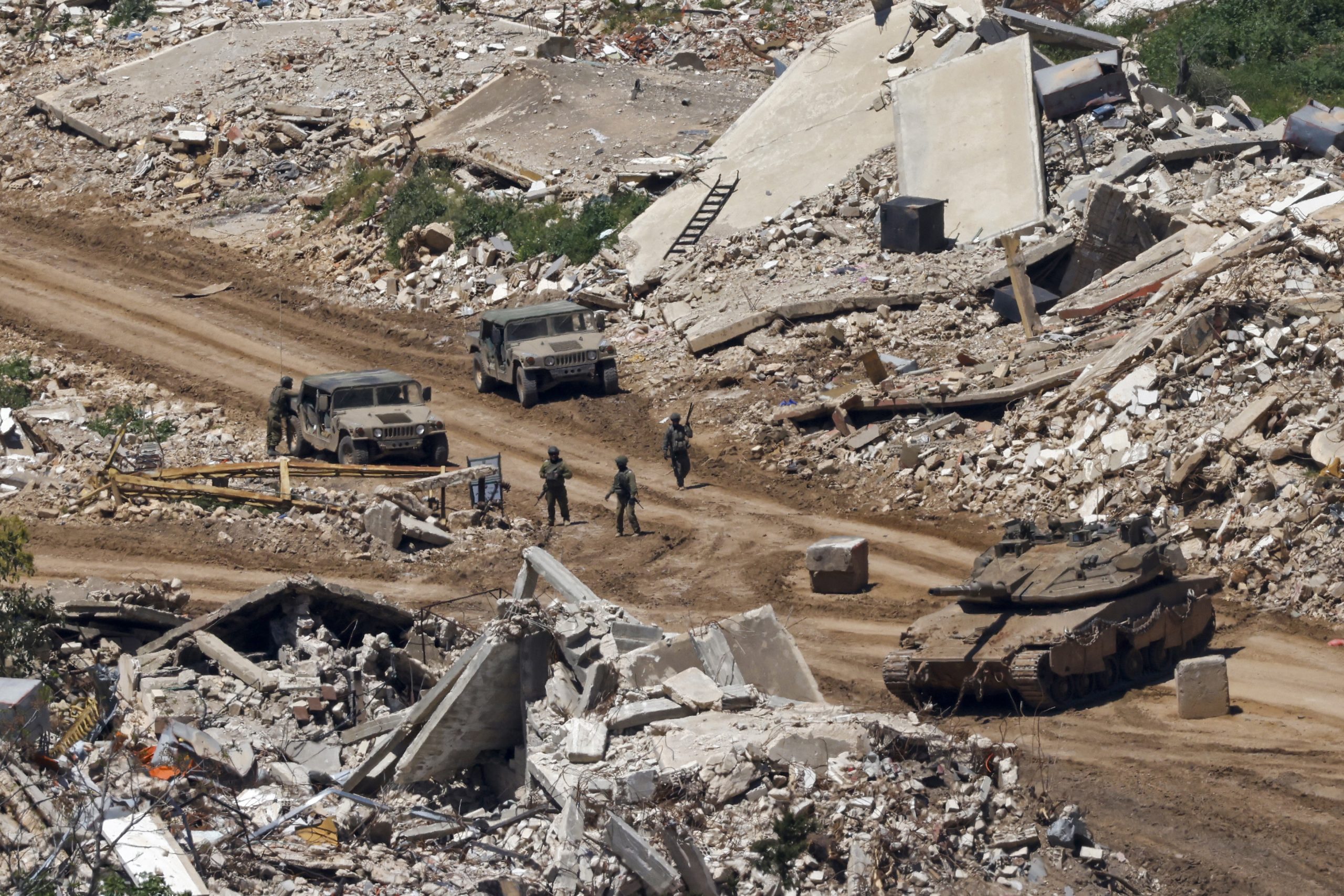
Making matters worse, “the political-security cabinet, and more specifically [Israeli Prime Minister Benjamin] Netanyahu, is pushing for overt operations in order to demonstrate an Israeli presence in southern Lebanon,” the senior IDF official posited. “At the same time, due to commitments and demands made by [U.S. President Donald] Trump, the operational freedom of the forces is being heavily restricted. It is a classic Catch-22 situation.”
“The result is severe harm to our soldiers and a weakening of the IDF against an enemy that is bound by no rules or constraints,” our source continued. “This is a dangerous and absurd asymmetry – sheer recklessness.”
His comments came a day before Netanyahu officially ordered a much larger Israeli push into southern Lebanon, despite the ongoing ceasefire, which you can read more about in our story from earlier today here.
The IDF says about 158,000 square meters of protective nets have already been distributed to units in the field, Israel’s I24 News reported.
“The army says it is in the process of acquiring an additional roughly two million square feet of netting,” the outlet added. “Altogether, the total area ordered is equivalent to roughly 20 football fields, highlighting the scale of Israel’s efforts to adapt its defenses to a rapidly evolving battlefield threat along the northern front.”
Even that much netting does not appear to be enough, given the scope of Israel’s push into southern Lebanon. That may be way some soldiers are looking to fishing nets to fill in the gaps.
Since the war in Ukraine began, troops have done whatever they could, often out of desperation, to develop improvised workarounds to protect against drones, from stacking logs on their vehicles to welding on layers of steel to create so-called “turtle tanks.” These and many other ad-hoc improvements have led to major innovations and a long list of dead-ends. Often times, even simple solutions can be hard to realize due to bureaucracy. Israel’s troops are no different, and their work to find their own solutions is yet another example of even the world’s most capable militaries underestimating and being unprepared for the realities of drones on the modern battlefield.
Contact the author: howard@twz.com
editor's pick
latest video

news via inbox
Nulla turp dis cursus. Integer liberos euismod pretium faucibua