This post was originally published on this site.
India Rejects BRICS Currency — Everyone Rejects BRICS Currency, U.S. Dollar Remains King
This post was originally published on this site.

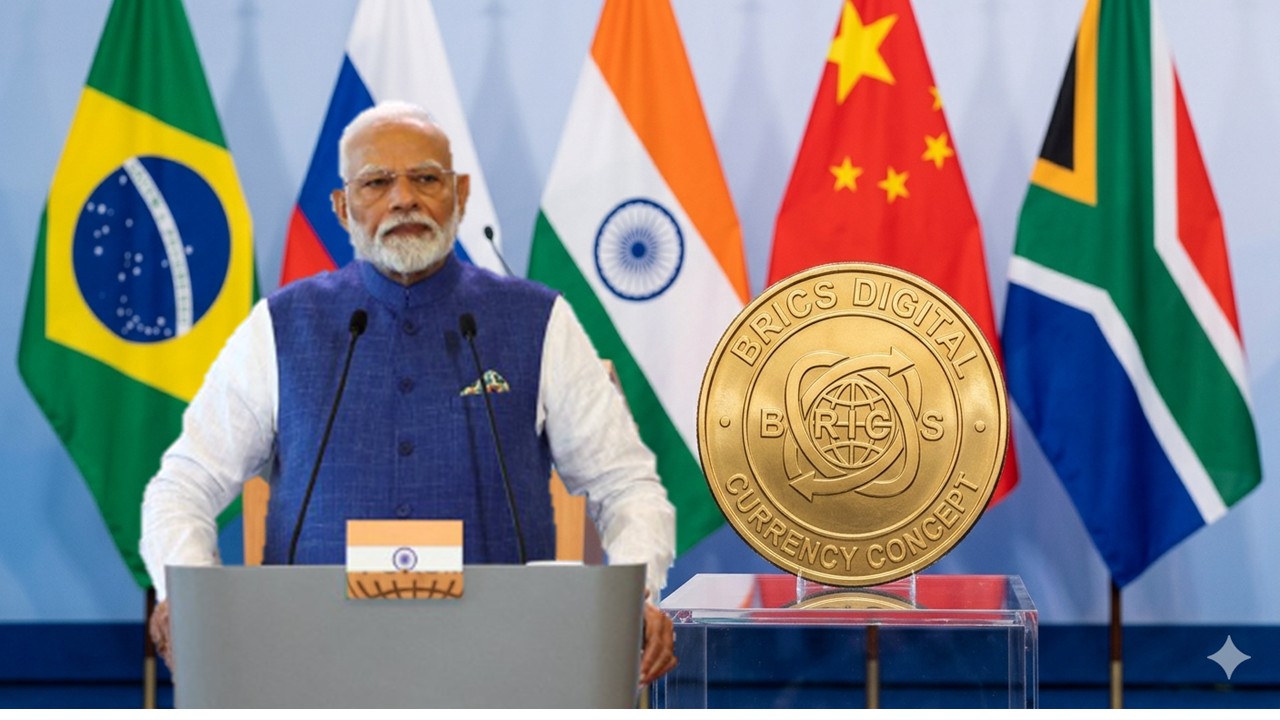
India has formally declined to join a proposed BRICS common currency while separately floating a digital payment proposal for the bloc’s 2026 summit. Neither proposal has been accepted by the BRICS countries, and neither is feasible. This is why the U.S. dollar will remain the world’s primary reserve and exchange currency, including among BRICS members, whose currencies are all weaker than those of any G7 country.
The Reserve Bank of India has proposed that BRICS nations establish a system allowing cross-border trade and tourism payments to be settled directly in each country’s own national digital currency, bypassing dollar-denominated correspondent banking and SWIFT.
The currencies themselves would remain fully distinct and sovereign; no BRICS currency would be created, elevated, or internationalized. It would not create reserve demand for any BRICS currency and would not affect the dollar’s reserve status.
The proposal has not been adopted by the Indian government, let alone any BRICS partner. In fact, it faces obstacles significant enough to make its realization unlikely on an unlimited timeline. No BRICS nation has fully launched its central bank digital currency. Brazil, Russia, India, and China are in pilot phases; South Africa remains at the research stage. Newer BRICS members Saudi Arabia and Ethiopia remain in the exploratory phase.
Beyond readiness, the technical and political barriers are substantial. For the system to function, interoperable technology standards, common governance rules, and mechanisms to handle trade imbalances across currencies would all need to be negotiated and agreed. Each element presents technical challenges around system interoperability, legal challenges around compatibility with WTO and IMF rules, and political challenges around governance and power distribution.
Establishing trust among participating nations is itself a critical obstacle. The geopolitical record on CBDC cooperation is not encouraging: the most advanced cross-border CBDC project attempted to date, mBridge, which involved China, Hong Kong, Thailand, the UAE, and Saudi Arabia, saw the Bank for International Settlements exit the project in 2024.
The BIS general manager stated explicitly that the institution “cannot directly support any project for the BRICS” because it cannot operate with sanctioned countries, naming Russia and Iran as BRICS members that trigger that constraint.
On the question of a shared currency, India’s position is unambiguous. At the IT-BT Round Table 2025 in New Delhi, Union Commerce Minister Piyush Goyal stated: “We are on record. We don’t support any BRICS currency. Imagine us having a currency shared with China. We have no plans. It is impossible to think of a BRICS currency.” Foreign Minister S. Jaishankar, speaking at Chatham House in March 2025, called the dollar a “source of international economic stability” and said India has “absolutely no interest” in undermining it.
India is not alone. South Africa’s Ambassador Ebrahim Rasool warned in March 2025 that BRICS members must avoid actions antagonizing the U.S., noting that not even China was actively pursuing de-dollarization at that point, and that Brazil dropped common currency plans from its 2025 BRICS presidency agenda after Trump’s tariff threats. The reluctance is grounded in financial reality.
BRICS currencies are largely non-convertible, and no country, including BRICS members themselves, holds significant reserves in any of the others’ currencies. The yuan’s reserve share had been overtaken briefly by both the Australian and Canadian dollars in global holdings and distrust of it extends within BRICS itself: when Russia demanded in 2023 that India pay for oil in yuan, India refused, insisting on dollars or rupees.
According to the Federal Reserve’s 2025 report, the dollar comprised 58 percent of disclosed global official foreign reserves in 2024, far surpassing the euro at 20 percent, the yen at 6 percent, the pound at 5 percent, and the renminbi at 2 percent. The most recent IMF COFER data for Q4 2025 puts the yuan’s share at 1.95 percent, down from 2.8 percent in 2022, while the ruble, rupee, and rial are nearly absent from global reserve holdings entirely.
The dollar’s decline from roughly 72 percent in 2001 is frequently cited as evidence of a broad abandonment of the greenback. The data do not support that reading. The overwhelming share of that decline is attributable to the creation of the euro and its adoption as the common unit of trade and finance within the eurozone. The euro’s share of global reserves has held at roughly 20 percent for over a decade and has shown no meaningful expansion, according to the European Central Bank.
The euro has not internationalized beyond Europe. The dollar remains the dominant reserve and exchange currency across Asia, Africa, Latin America, and the Middle East. IMF Q2 2025 COFER data further weakens the de-dollarization narrative: 92 percent of the dollar’s reserve share decline in that quarter was driven by exchange-rate effects, not active central bank portfolio changes. Adjusted for constant exchange rates, the dollar’s share edged down only 0.12 percent, indicating central banks largely maintained their dollar holdings.
India’s refusal underscores the internal divisions within BRICS, raising questions about the bloc’s long-term cohesion. A shared currency requires convertibility, reserve depth, and political trust among members, none of which currently exists across the bloc. The dollar, for all the rhetoric directed against it, remains the default.
Any serious path to a BRICS currency, or even a functional multilateral digital payment system, would require BRICS currencies to become hard currencies. They would need to be freely convertible, liquid, stable in value, and backed by deep capital markets and credible institutions operating under the rule of law.
The requirements for reserve-currency status are well established. A currency must be supported by large, open, and liquid financial markets; credible and independent monetary policy; full convertibility with minimal capital controls; transparent governance; and the rule of law. Not one BRICS currency meets these standards.
The ruble is no longer freely convertible and operates under extensive capital controls imposed after the 2022 sanctions. The yuan maintains a closed capital account that restricts the free flow of currency in international markets. This makes it less attractive to central banks and global investors, who require reserve currencies to be freely convertible and readily available during liquidity crises.
The rupee faces major convertibility and volatility concerns that limit its use even in trade between India and Russia. The real and rand are hindered by currency volatility and the relatively small size of their economies and financial systems. The Ethiopian birr ranked as the world’s third-weakest currency in 2025, depreciating more than 165 percent against the dollar in just 15 months.
By contrast, every G7 currency, including the dollar, euro, pound, yen, Canadian dollar, and Swiss franc, is freely convertible, widely held in global reserves, and traded in deep, transparent markets. No BRICS currency comes close.
Until BRICS countries dramatically improve their economies, internationalize their currencies, and convince the rest of the world to accept them, the U.S. dollar will remain king.
The post India Rejects BRICS Currency — Everyone Rejects BRICS Currency, U.S. Dollar Remains King appeared first on The Gateway Pundit.
editor's pick
latest video

news via inbox
Nulla turp dis cursus. Integer liberos euismod pretium faucibua