Exclusive—Richard Samuelson: Founding Friendship: In Life and in Death John Adams and Thomas Jefferson Were Bound by July 4
In life and in death, the lives of John Adams and Thomas Jefferson are bound up with American independence and our Declaration of Independence. As many Americans know, the two patriots died on the first great anniversary of Independence, July 4, 1826.
The contrast between the concerns of 1776 and the celebrations of 1826 are hard to understate. In July 1776, the British King had sent the largest military force ever sent to the Americas to subdue the colonists. On July 2, 1776, the day on which Congress voted that “these colonies are and of right ought to be free and independent states,” the troops began landing in New York. There was no guarantee that the Americans would succeed. And yet they believed they would. As John Adams wrote his wife, Abigail, on July 3, “I am well aware of the Toil and Blood and Treasure, that it will cost Us to maintain this Declaration, and support and defend these States. — Yet through all the Gloom I can see the Rays of ravishing Light and Glory.” And, he noted, should we succeed, Independence Day should become an annual festival that “ought to be commemorated, as the Day of Deliverance by solemn Acts of Devotion to God Almighty. It ought to be solemnized with Pomp and Parade, with Shews, Games, Sports, Guns, Bells, Bonfires and Illuminations from one End of this Continent to the other from this Time forward forever more.”
If we lost Jefferson, Adams and the others who became our founding fathers would hang. As it was illegal in British law for a British subject to renounce his allegiance to the King, the first and only evidence the British would need in a trial would be a copy of the Declaration with their signature on it. That was the bravado in John Hancock’s line about signing the Declaration in letters large enough for the King to read it without his spectacles. In short, signing the Declaration was no laughing matter, and pledging their lives, fortunes, and sacred honor was more than mere rhetoric. Even John Dickinson, the leading opponent of the Declaration in July 1776, was in the same boat. And where did he go after the vote? To New York, where he would lead troops in our fight against the British.
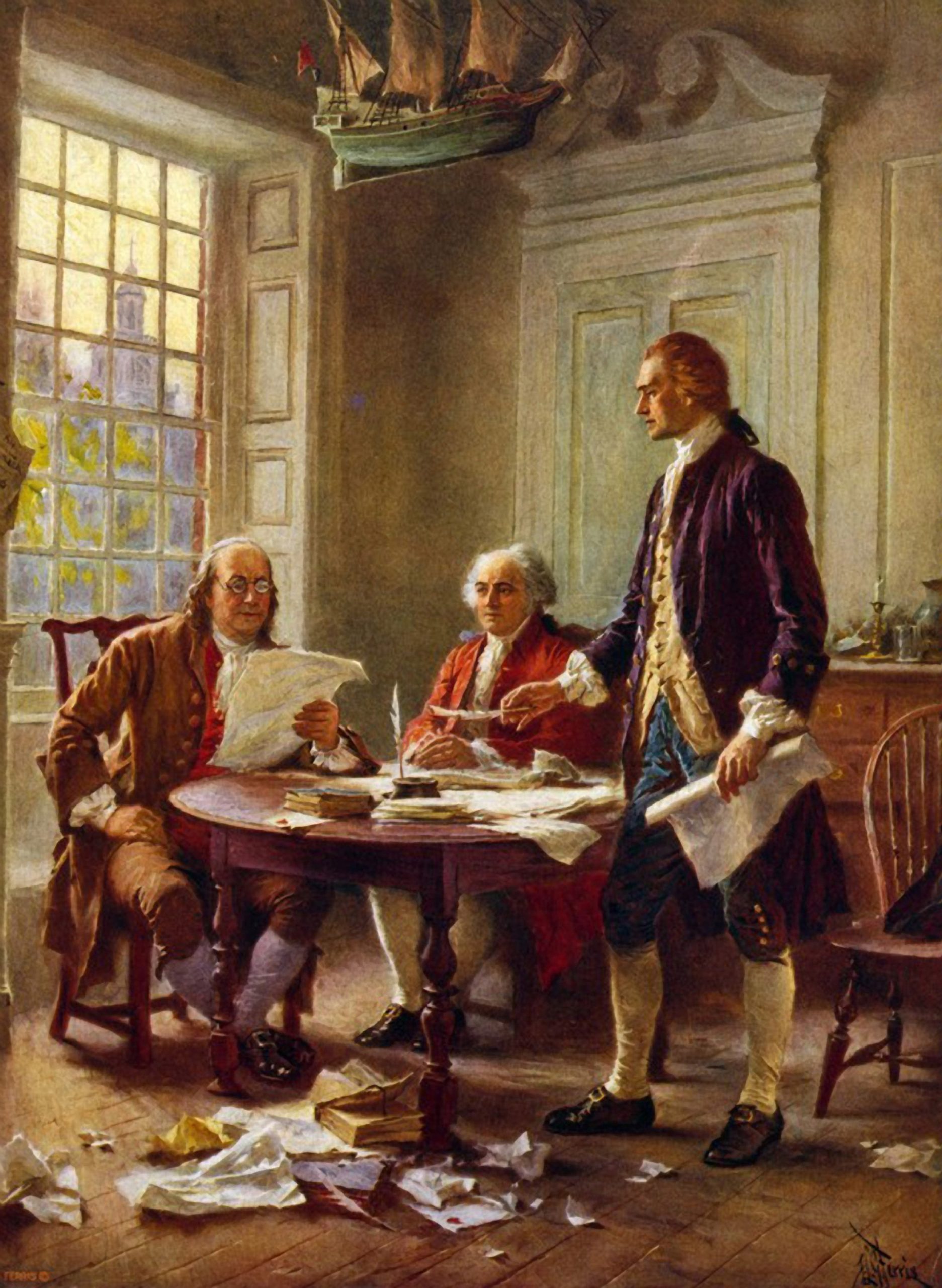
“Writing the Declaration of Independence, 1776” depicting Benjamin Franklin, left, John Adams, and Thomas Jefferson, standing, meeting in Philadelphia to study a draft of the document. Painting by J.L.G. Ferris. (Getty Images)
But the men of 1776 did not despair. There were some close calls, for Adams and Jefferson. Adams nearly died an icy death when his ship, chased by the British, sprung a leak on the treacherous crossing of the Atlantic in late 1779 when he was sent to serve as our lead diplomat if, or when, it was time to negotiate a treaty with Britain to secure Independence. And the British nearly caught Jefferson at Monticello in 1781, when he had just completed his term as Virginia’s governor, when they invaded the state in the latter part of the war. And dangerous it was for the other men of 1776, in Congress and out. Perhaps with the aid of Providence, we won the war. Jefferson would later describe it as “the bold and doubtful election we were to make for our country, between submission or the sword.”
How different it was in 1826, the Golden Anniversary of Independence. The nation was secure and prospering. We had a government that secured the rights of men better than any government known in previous history. And we had defeated the British, or, at least, fought them, the greatest power on earth, to a draw in the War of 1812. To be sure, there were problems, most notably the problem of slavery. By then the North had abolished slavery, and slavery had been kept out of the Northwest, but it remained in the South. And the cotton revolution that began in the early 1790s had given new life to the institution and helped it spread across the South. But in general, Americans had much to be proud about as we celebrated our Golden Anniversary.
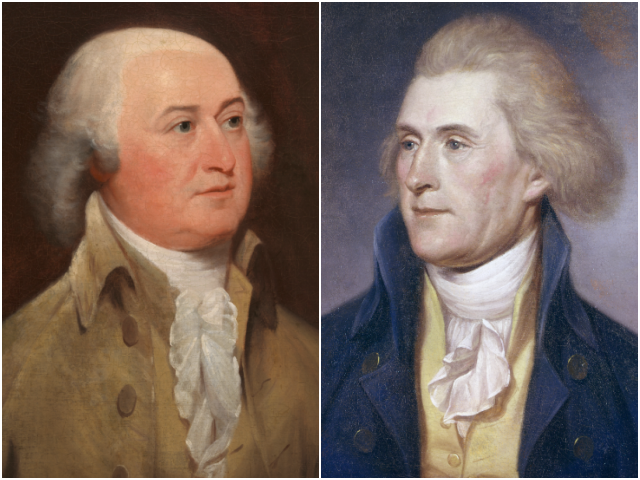
Left: Portrait of John Adams, circa 1793, by John Trumball. Right: Portrait of Thomas Jefferson, circa 1791 by Charles Wilson Peale. (Getty Images)
In the 1780s, John Adams reflected upon the Providential opportunity Americans had, thanks to the peculiar circumstances of their Revolution: “The people in America have now the best opportunity and the greatest trust in their hands, that Providence ever committed to so small a number, since the transgression of the first pair.” In his last public letter, celebrating the 50th anniversary of Independence, Jefferson was confident that Americans were well on their way: “All eyes are opened, or opening, to the rights of man. The general spread of the light of science has already laid open to every view the palpable truth that the mass of mankind has not been born with saddles on their backs, nor a favored few booted and spurred, ready to ride them legitimately, by the grace of God.” The two patriots were as responsible as anyone for the success of the republic.
Both Jefferson and Adams were invited to join the festivities to take place on July 4, 1826. Both had to beg off, citing age and ill health. Little did Americans know the full story that was to unfold. Both men, united in life in American Independence, were to be united in death. As Americans were celebrating, Adams and Jefferson were to breathe their last.
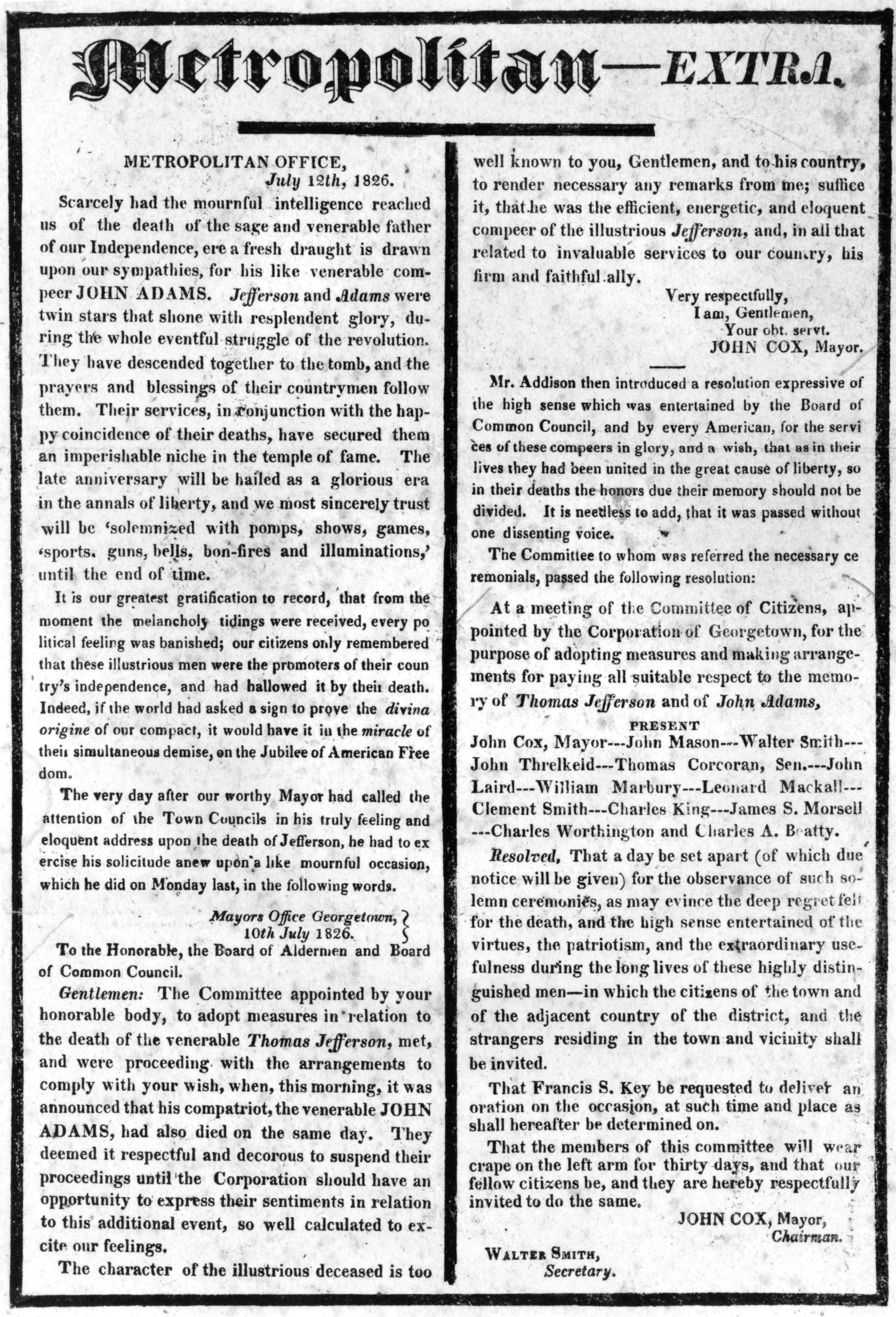
12th July 1826: A special edition of the Metropolitan newspaper printed to mark the recent deaths of former U.S. presidents Thomas Jefferson and John Adams. Both men died on 4th July, 1826, on the 50th anniversary of the Declaration of Independence. (Photo by MPI/Getty Images)
By then, they were dear friends again. Amid the partisan rancor of the 1790s they had been estranged. In the early 1800s, the friends and partners of 1776 were no longer on speaking terms. But that would not last.
Their mutual friend and fellow man of 1776, Benjamin Rush, worked to reconcile them. On October, 17, 1809, perhaps not coincidentally the anniversary of the great American victory in the battle Saratoga, which was a key turning point of the war for Independence, Rush wrote Adams of a dream he had. He dreamed he saw a history book recording events of 1809: “Among the most extraordinary events of this year was the renewal of the friendship and intercourse between Mr. John Adams and Mr. Jefferson, the two ex-Presidents of the United States. Their principles of liberty, their ardent attachment to their country” had forged their friendship in Philadelphia in 1776. And, he added, again with remarkable prescience: “These gentlemen sunk into the grave nearly at the same time, full of years and rich in the gratitude and praises of their country.”
They were bonded, in death, as in life, by American Independence. As Daniel Webster put it in his celebrated Eulogy of the two patriots:
Neither of these great men, fellow-citizens, could have died, at any time, without leaving an immense void in our American society. . . .But the concurrence of their death on the anniversary of Independence has naturally awakened stronger emotions. Both had been President, both had lived to great age, both were early patriots, and both were distinguished and ever honored by their immediate agency in the act of independence. It cannot but seem striking and extraordinary, that these two should live to see the fiftieth year from the date of that act/ that they should complete that year/ and that then, on the day which had fast linked for ever their own fame with their country’s glory, the heavens should open to receive them both at once. As their lives themselves were the gifts of Providence, who is not willing to recognize in their happy termination, as well as in their long continuance, proofs that our country and its benefactors are objects of His care?
As we approach this 250th anniversary of Independence, it is fitting that we celebrate it, as Adams said we should, with fireworks, games, bonfires, etc. Be we should not neglect acts of gratitude to God and to the men of 1776. In short, we could do worse than to spend some time remembering Adams, Jefferson, and the other men of 1776, as we express our gratitude to God for their lives, their life’s work, and the country that we, under God’s Providence, are blessed to live in.
Richard Samuelson is an Associate Professor of Government at Hillsdale College’s Washington, DC, campus.
editor's pick
latest video

news via inbox
Nulla turp dis cursus. Integer liberos euismod pretium faucibua