Colleges to blame for declining trust as Americans question the ‘purpose and mission’ of higher education: Yale report

A new report out from Yale University on Trust in Higher Education reveals that colleges and universities are in large part to blame for the decline in American higher education. The report states that there are “three immediate factors behind the rise of public distrust,” including the insane cost of tuition, mistrust in the admissions process, and concern over curriculum.
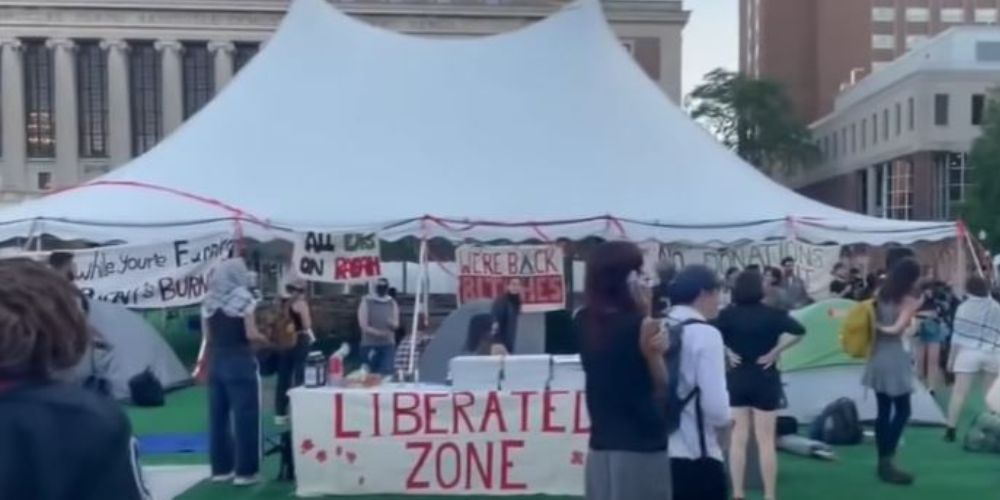
The Trump administration has attempted to deal with all three of these. Students are being made to pay back their student loans under Trump, where Biden attempted to give loan forgiveness—which simply incentivizes schools to charge even more in tuition knowing that it is free government money. Affirmative action has been struck down by the Supreme Court, and the Trump administration has demanded that schools remove their DEI practices that prioritize identity over merit. In the realm of curriculum and free speech, the Trump administration has endeavored to hold schools accountable for discriminatory practices such as the tentifada Gaza camps and has pushed back against the anti-America sentiment that is de facto in many schools.
That third factor, as the report states, “includes an array of issues about what is said and taught on university campuses, including matters of free speech, political bias, and self-censorship.” These are concerns that have been highlighted in recent years by right-wing media and academically critical outlets who have discovered that the Marxist pedagogy and critical theory pushed at universities does nothing to prepare students for life or to deepen their scholarship.
The report states that an additional “challenge related to declining trust” is the “widespread uncertainty about the fundamental purpose and mission of higher education.” The public is not just losing trust in institutions, trust in universities is almost gone. Americans, the report notes, do want universities to succeed, but “on terms that feel fair, affordable, and aligned with public purpose.”
Admissions have been given over to affirmative action, in which white and Asian students are routinely discriminated against to make room for less-achieving minority students. Tuition has increased drastically, with many schools coming in at over $60,000 per year just for the cost of course credits—Yale is closer to $70,000.
Students take out massive government loans to cover the cost then graduate school with debilitating debt. Further, the courses taught are often absurd, with titles at the soon-to-be-shuttered Hampshire College like “Deviant Bodies” or “Indigenous Nihilism.” Much of the course catalogue at small, liberal arts schools could be summed up as “Learn to Hate America.”
The committee, made up of tenured Yale faculty across disciplines, realized that schools exist “not only to educate students and preserve cultural heritage, but also to push the frontiers of knowledge.” Schools have not, in recent years, seen themselves as the preserver of cultural heritage, but the destroyers of it.
Tuition costs at many schools is a much deeper story than just the ticket price. Financial aid is a huge component of university budgets and very few students pay the actual sticker cost of the stated tuition. At Yale, “approximately one in five undergraduate students attends Yale on a full ride, paying nothing for four years of education, including tuition, room and board, travel, books, and personal expenses. More than 55 percent of undergraduates receive some level of need-based aid, and almost 90 percent graduate with no student loan debt.”
However, as the committee notes, “From the perspective of building public trust, though, it would be hard to design a more ineffective system. The tuition sticker price may now be a fiction for many students, but it is the first thing most families see when they contemplate paying for college.”
The admissions process is opaque—no one ever really knows why they get into college. The committee writes that “the absence of any clear academic standard is difficult to reconcile with a mission built on academic excellence. When selective admissions seem so inexplicable—or, worse, tilted in ways that benefit the already advantaged—it should come as no surprise that many Americans do not trust the process.”
Free speech was once “the essential precondition for university life, without which there can be no open debate or honest search for truth.” But in recent decades, American universities have abandoned this mission entirely. Cancelings of professors, the lack of conservative voices at all either in faculty or administration, student bodies captured by ideological hegemony over climate, trans, Gaza, abortion, have all contributed to the feeling that there is no quarter for free speech on campus.
The committee writes that “the campus has not been immune from pressures toward conformity, intimidation, and social shaming that have affected the rest of higher education and, indeed, the rest of American society. Adding fuel to the fire is the fact that a great deal of campus life is now lived online. Phones and cameras are ubiquitous, and videos of controversial confrontations now drive much public conversation about higher education.”
Studies have shown that while there are conservatives on campuses, they keep their mouths shut, self-censoring in a place that should be a bastion of open discourse. Universities have seen massive protests against speakers such as Michael Knowles, Riley Gaines, and conservative thought leader Charlie Kirk was murdered during a free speech event on a college campus in September 2025. Students do not feel free to express their political or religious beliefs and feel intimidated into silence. Conservatives, specifically, across the US no longer have trust in academia writ large.
The committee lists recommendations for universities to win back the trust of the American people. They offer 20 recommendations for Yale specifically, but universities across the board, to undertake: take responsibility, focus on the mission, protect free speech, support academic freedom, make higher education affordable, reform undergraduate admissions, open minds, deliver educational value, open the gates, re-center the classroom, pay attention, resist self-censorship, grade like we mean it, be human, create common knowledge, govern collaboratively, streamline bureaucracy, build trust with the trustees, communicate effectively, and lead by example.
All of these recommendations sound worthwhile, but if there’s anything Americans have learned over the past decade, it’s that definitions matter. If Yale, and universities across the US, try to fix these problems using the same tools that created them, there will be no difference made at all.
Report of the Committee on Trust in Higher Education by The Post Millennial
editor's pick
latest video

news via inbox
Nulla turp dis cursus. Integer liberos euismod pretium faucibua