China’s Big R6000 Tiltrotor Drone Has Entered Full Flight Testing
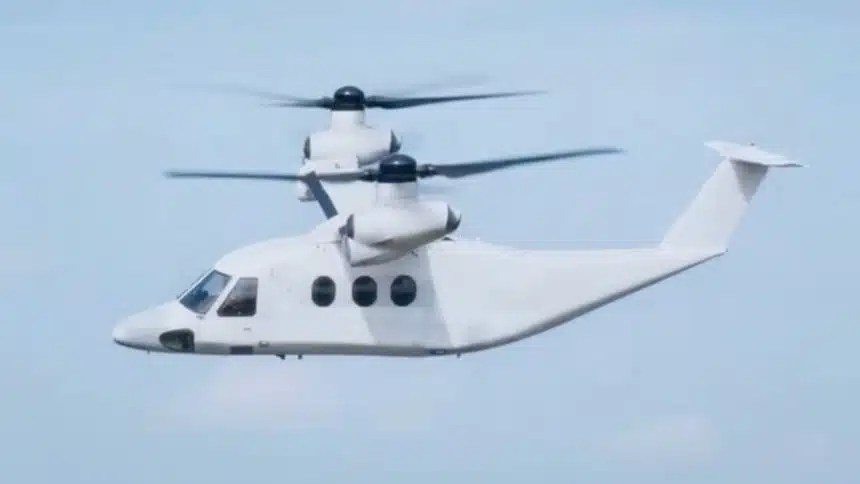
A newly emerged video offers what appears to be a first look at China’s R6000 uncrewed tiltrotor aircraft in free flight, marking a significant step beyond the tethered hover tests that had been seen previously. The design has attracted interest on account of its similarities to Bell’s MV-75A Cheyenne II, America’s crewed second-generation tiltrotor. More broadly, the development of this aircraft could have very significant implications for the People’s Liberation Army as well as civilian operators.
The footage, which first appeared on Chinese social media, shows the large drone in vertical flight, making a pedal turn (rotating around its vertical axis in the hover), and in sustained forward flight with its twin proprotors fully tilted. Previous imagery was limited to tethered evaluations that demonstrated basic hover capability. Now, with flight testing advancing, more could be revealed about the aircraft’s performance envelope.
As in the previous imagery, the aircraft’s engines are unshrouded, with their streamlined fairings removed. Like the MV-75, the R6000 features fixed engine nacelles with hinged proprotors, in contrast to the first-generation tiltrotor design found on the V-22 Osprey, in which the entire nacelle pivots up and down as a complete unit.
Previous imagery showing the R6000 conducting a tethered hover test had begun to circulate last November, as we discussed at the time.

While no details have been released about the scope of the current trials, the ability to conduct sustained untethered flight is a key milestone for any tiltrotor program, given the complexity of the aircraft’s aerodynamics and flight-control systems. Tiltrotor designs are especially challenging, as evidenced by the V-22’s checkered record through the years.
In October 2024, a photo emerged showing the first completed prototype of the R6000 at the Wuhu United Aircraft Production Workshop in China’s eastern Anhui province. United Aircraft had unveiled the design, also referred to as the UR6000 and Zhang Ying (or Steel Shadow), at the 2024 Singapore Airshow.

Developed by the Chinese firm United Aircraft, the R6000 is one of the largest uncrewed tiltrotor designs currently in development anywhere in the world. Combining the vertical takeoff and landing capabilities of a helicopter with the speed and range advantages of a fixed-wing aircraft, it is — officially, at least — aimed at logistics, disaster relief, offshore support, and other missions requiring access to areas without prepared runways. United Aircraft has presented both crewed and uncrewed versions of the R6000 in the past.
As we have outlined previously, a crewed or uncrewed tiltrotor in the R6000 class could fulfill various military applications for the People’s Liberation Army (PLA).

The aircraft would be particularly valuable for sustaining PLA island bases in the South China Sea, as well as isolated installations elsewhere in the Pacific and along China’s remote border regions, where conventional airfield infrastructure is limited.
This kind of aircraft could support overseas deployments and regional contingencies, including a potential operation against Taiwan, by moving troops, supplies, and equipment between dispersed locations without relying on prepared runways.
In particular, the R6000 would be well suited to operating from the Type 076 amphibious assault ship and other large People’s Liberation Army Navy (PLAN) amphibious ships, greatly extending their reach for logistics, reconnaissance, and other missions.

As well as logistics, a fully developed R6000 has clear potential as a multi-mission platform. Its payload capacity could also accommodate intelligence, surveillance, and reconnaissance (ISR) equipment, electronic warfare payloads, communications relay systems, or potentially even precision-strike weapons. It is worth noting at this point that a special operations version of the MV-75 is already in the works, with a gunship variant likely, and a sea control concept has been displayed, too. China is likely to at least explore similar development paths for its tiltrotors.
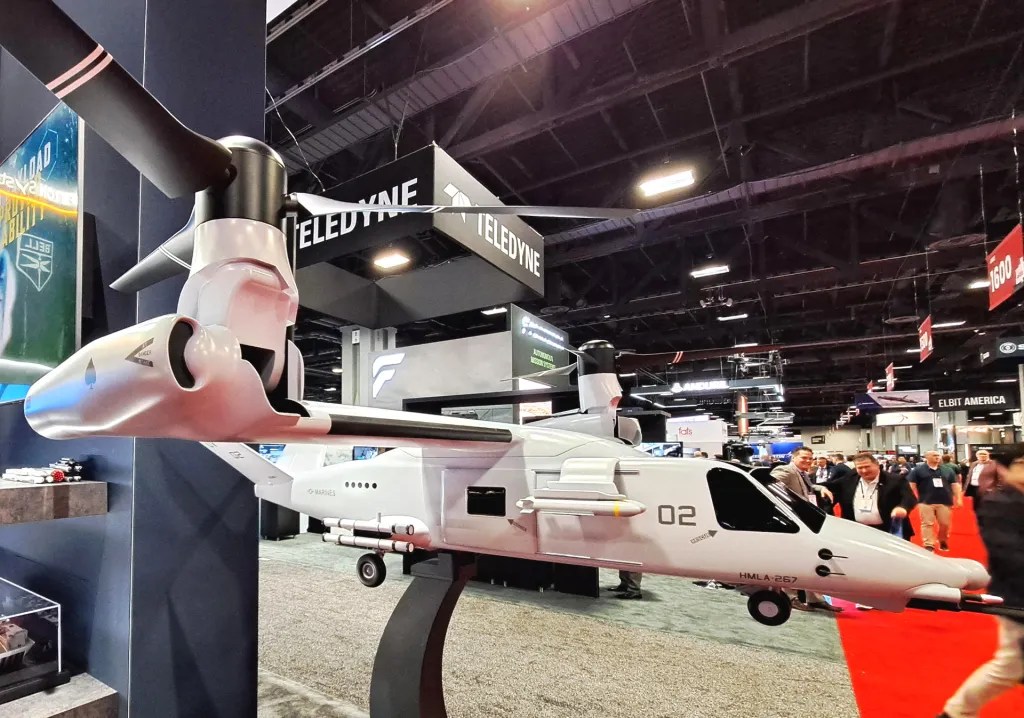
In this respect, the R6000 also makes for an interesting comparison with Bell’s V-247 Vigilant, which was originally pitched to meet the U.S. Marine Corps multirole, VTOL-capable drone program, known as MUX. The V-247 has also been pitched to the U.S. Navy, while Bell has presented renderings showing V-247s operating together with the crewed V-280 Valor tiltrotor design, which the U.S. Army’s MV-75 is based on.

When it comes to advanced uncrewed aviation, this is an area that China has invested heavily in over the past decade. Its projects span everything from smaller tactical drones to high-altitude reconnaissance platforms and increasingly sophisticated combat drones. The R6000 fits squarely within Chinese efforts to develop a range of uncrewed transport aircraft, including developing large autonomous logistics aircraft capable of operating in challenging environments.

In the vertical-lift segment, China is also busily exploring crewed tiltrotor designs.
Earlier this month, new footage emerged showing what is understood to be China’s first crewed tiltrotor aircraft during flight trials. That aircraft had first broken cover in August of last year, as we wrote about at the time.
Although the R6000 has, in the past, been pitched primarily for civilian applications, the technology has obvious military relevance. Large autonomous tiltrotors could provide rapid resupply to dispersed forces, support operations in remote regions, or deliver cargo to ships and austere bases without the need for conventional runways. Tiltrotors have huge potential for the PLA, which has major littoral mission demands and a growing fleet of amphibious warships to which these kinds of aircraft are especially well suited.
As such, the R6000 is worth watching as another indicator of the Chinese military’s increasingly ambitious vertical-lift programs, as well as its diverse and growing series of uncrewed aircraft.
Contact the author: thomas@thewarzone.com
editor's pick
latest video

news via inbox
Nulla turp dis cursus. Integer liberos euismod pretium faucibua