7,800 Interceptors In Space At Core Of $1.2 Trillion Golden Dome Cost Estimate
It could cost nearly $1.2 trillion to develop, field, and operate a new missile defense shield like the one the Trump administration proposes to establish under its Golden Dome initiative, according to a new estimate. Deploying and sustaining a constellation of 7,800 space-based anti-missile interceptors accounts for more than 60 percent of that projected price tag. This puts a particular spotlight on the potential costs of what is arguably viewed as the most critical and controversial aspect of the Golden Dome plan. At the same time, even with this grand investment, the ability of the space-based interceptor layer would only be able to engage 10 targets simultaneously, according to the Congressional Budget Office (CBO).
CBO released a detailed cost estimate of what it described as a notional “National Missile Defense System” yesterday. CBO’s $1.191 trillion figure covers various expenses over a 20-year timeframe. This is more than double the projected price tag that CBO had put forward last year. President Trump first announced plans for a new national missile defense architecture in January 2025. The initiative was originally dubbed Iron Dome before being renamed Golden Dome.

“The analysis is based on the objectives laid out in the President’s executive order titled ‘The Iron Dome for America.’ The Department of Defense’s (DoD’s) implementation of that order – an initiative now called the Golden Dome for America (GDA) – is in the early stages,” CBO’s latest estimate explains up front. “Although documents from DoD’s budget request for the 2027 fiscal year provide five-year projections of funding plans for GDA, details about what and how many systems will be deployed – the ‘objective architecture’ – have not been released, making it impossible to estimate the long-term cost of the GDA system being contemplated by DoD. In the absence of specific plans for GDA’s objective architecture, CBO has estimated the cost of a notional NMD architecture based on the defensive systems and capabilities that are called for in the executive order.”
“DoD’s stated cost appears to cover a shorter time frame than CBO’s analysis and may reflect a different scope of activities and budget categories. Even so, that stated cost is far lower than CBO’s estimate for a notional NMD architecture consistent with the ‘Iron Dome” executive order,” CBO’s assessment adds. “That difference suggests either that GDA’s objective architecture is more limited than CBO’s notional NMD system or that DoD expects significant funding from other accounts to contribute to GDA (or both). For example, procurement of interceptors might be funded directly through the services’ missile procurement accounts instead of the GDA fund.”
For its part, the Trump administration has most recently pegged the price tag for Golden Dome’s “objective architecture” at approximately $185 billion. Last year, President Trump himself had put forward a $175 billion figure, which he said would include systems to be fielded “in less than three years.” TWZ has noted on several occasions now that the administration’s estimates may just cover a portion of the planned Golden Dome architecture, which could easily cost hundreds of billions in total to field and operate.
CBO’s analysis is broken into six main elements – the space-based interceptor constellation, upper wide-area surface sites, lower wide-area surface sites, regional sectors, self-defense for four existing surface sites, and a space satellite constellation for tracking targets – as well as a collection of miscellaneous ancillary costs. The surface site and regional sector categories primarily consist of costs associated with expanding on existing land and sea-based anti-missile interceptor and sensor capabilities, such as Aegis Ashore, the Terminal High Altitude Area Defense (THAAD) system, and the Next Generation Interceptor (NGI).
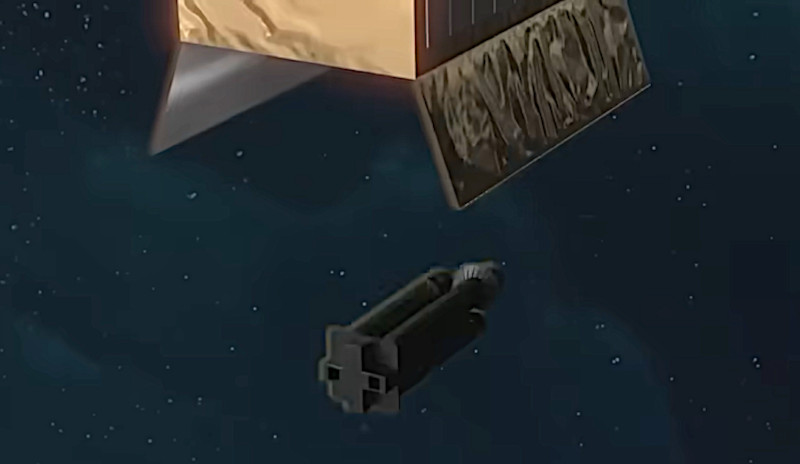
An all-new constellation of 7,800 space-based interceptors is, by far, the largest single component of CBO’s projection. This capability is estimated to cost $723 billion to acquire, and then another $1 billion annually to operate and maintain ($20 billion over 20 years), for a total of $743 billion. This is 60 percent of the total estimated $1.191 trillion price tag, and 70 percent of the projected acquisition costs.
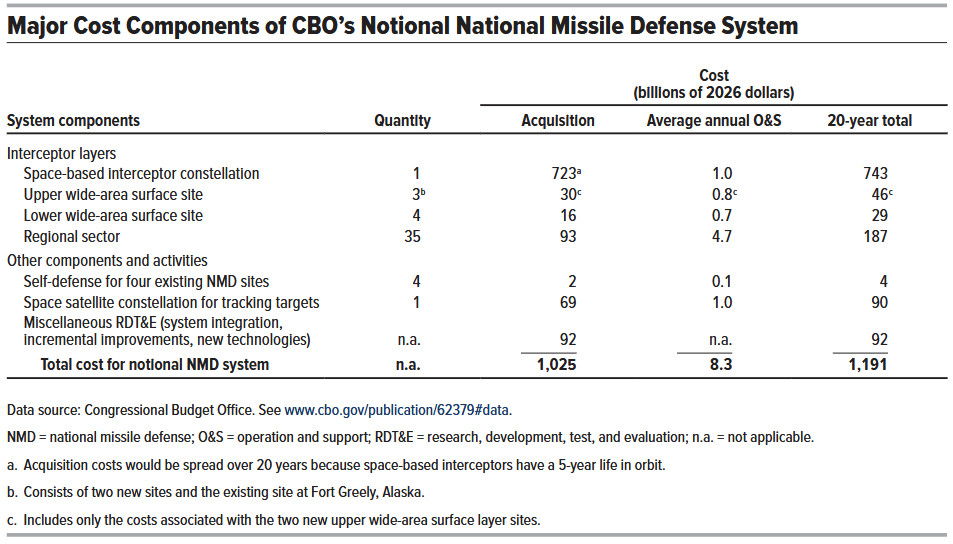
CBO provides a detailed breakdown of how it arrived at these figures.
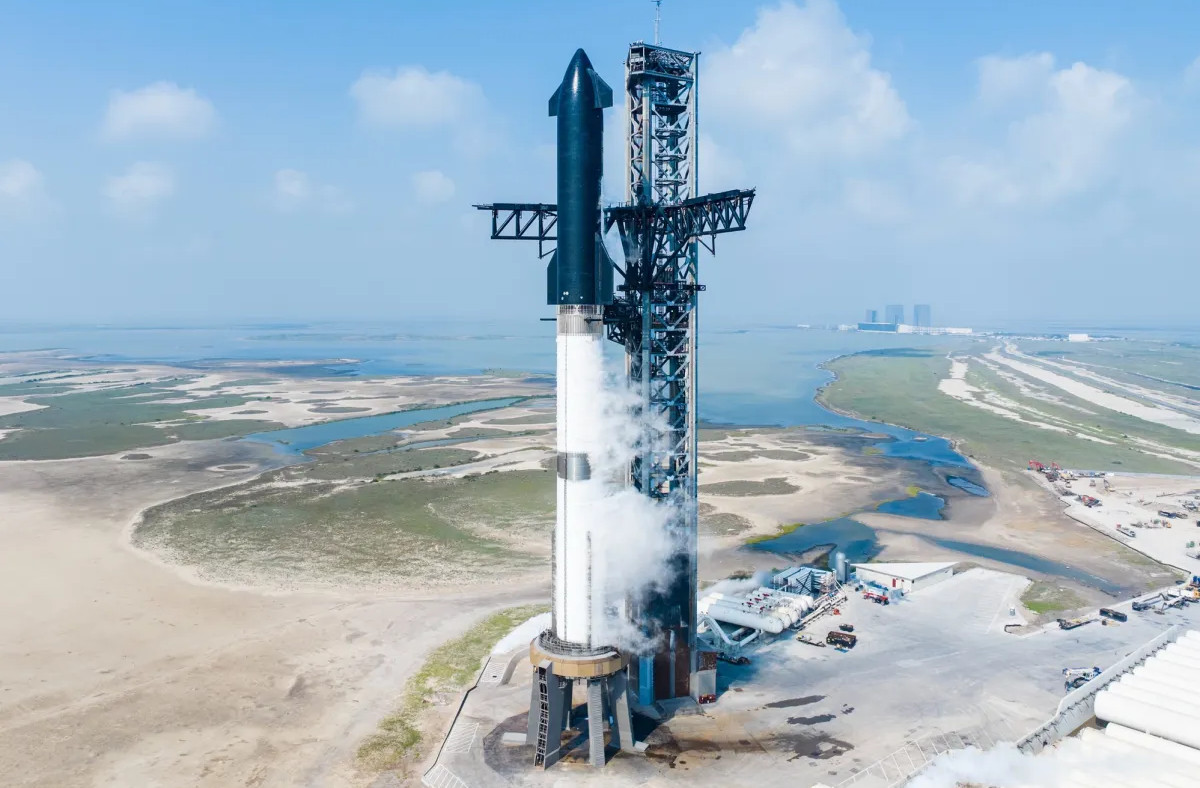
“The average cost per SBI [space-based interceptor] satellite would be $22 million. That average is for the initial 7,800 SBIs as well as the nearly 1,600 SBIs that would be needed each year thereafter because of the satellites’ short five-year service life. The need to periodically replace SBIs means that the acquisition costs would be spread over the life of the system,” according to the cost assessment. “The total is based on a cost of $500 per kilogram to launch the SBIs into orbit. Although that launch cost is lower than typical launch costs today, it is thought to be achievable using the new generation of heavy-lift rockets, such as the Space-X [sic] Starship, that are being developed. Even lower launch costs may be realized in the future, but that could have only a limited effect on total costs for the SBI layer because, even at $500 per kilogram, launch costs account for less than 5 percent of the total.”
“Both the very large number of SBIs needed to engage just 10 targets simultaneously and the SBIs’ short service life are the result of how the satellites move in orbit. To be close enough to reach their targets within the three to five minutes available in the boost phase, SBIs must be in LEO at altitudes of roughly 300 to 500 kilometers,” it continues. “However, the characteristics of satellite motion in LEO affect the size of constellations meant to provide continuous coverage over specific locations on Earth. (For boost-phase SBIs, “coverage” is relative to an ICBM’s [intercontinental ballistic missile] launch location, not the location of the ICBM’s target.)”
“Satellites in LEO cannot be fixed over specific points on Earth; they orbit in a band centered on the equator and bounded equally north and south by their orbital inclination (usually measured in degrees of latitude). Therefore, constellations of many SBIs are needed to ensure that a sufficient number (20, for example, if two shots are needed against 10 ICBMs) are always close enough to potential launch locations to reach targets during the boost phase,” the assessment adds. “The total number of satellites in a constellation depends mainly on the speed of the interceptors, how quickly they can be launched, the number of simultaneous targets the system needs to handle, and the latitudes to be covered.”
“Because atmospheric drag at the altitudes at which SBIs would orbit causes their orbits to decay over time, each satellite would need to be replaced roughly every 5 years. (By contrast, the service life of surface-based interceptors can be 20 years or more, and surface-based interceptors can be maintained and upgraded during that time.),” CBO also says. “For CBO’s notional constellation, roughly 30,000 satellites would be needed to keep 7,800 in orbit for 20 years.”
All this being said, CBO’s notional space-based interceptor architecture is still predicated only on defeating a relatively limited strike (a single wave of 10 ICBMs) from what “a regional adversary,” a term typically used to describe countries like North Korea and Iran. The Trump administration has indicated in the past that Golden Dome is intended to defend against a much broader array of threats, including from peer adversaries like Russia and China.
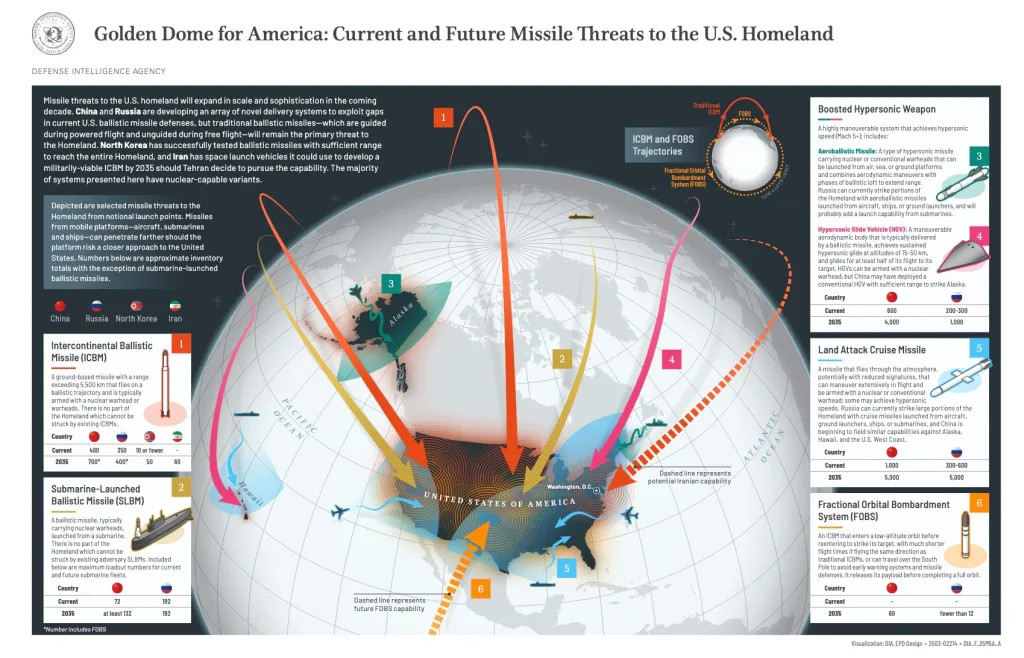
Furthermore, CBO points out that its cost estimate does not include additional space-based interceptors designed to engage missiles during the mid-course portion of their flight, which are also being explored now as part of the Golden Dome plan.
“Although the notional NMD system analyzed by CBO would be far more capable than defenses the United States fields today, it would not be an impenetrable shield or be able to fully counter a large attack of the sort that Russia or China might be able to launch,” the latest cost estimate also stresses. “As a result, the strategic consequences of deploying an NMD system with the capacity considered here are unclear because they hinge on an adversary’s perception of the defense’s capability and how that adversary chose [sic] to respond.”
“Such a deployment could prompt regional adversaries to increase their inventories of long-range missiles (nuclear or conventional) or to pursue more effective countermeasures to improve their chances of penetrating the NMD system,” the assessment notes. “Peer or near-peer adversaries could overwhelm CBO’s notional NMD system with salvoes of many missiles in a large-scale attack with their current nuclear forces, although they still might choose to increase their arsenals of long-range missiles (both nuclear and conventional) to ensure they maintain that capability.”
With this in mind, “DoD could opt to build a national missile defense system that was smaller or larger than (or altogether different from) CBO’s notional system. A larger system designed to handle a full-scale Russian ICBM attack, for example, could include more space-based interceptors or more NGIs at the three upper wide-area surface layer sites,” it also cautions. “It could also include more interceptors at lower levels. A smaller system, by contrast, might be able to engage fewer missiles or protect fewer areas. The total number of regional sectors in CBO’s notional system is based on providing some terminal coverage to the entire country as suggested by the language in the ‘Iron Dome’ executive order.”
As mentioned, putting interceptors in space has been one of, if not the highest profile aspect of the stated Iron Dome/Golden Dome plan from the very start. Space-based weapons were also a central element of the Reagan-era Strategic Defense Initiative (SDI), which was directly referenced in the original executive order outlining the new missile defense initiative. Infamously dubbed “Star Wars” by its critics, SDI never came close to achieving its ambitious goals. Its planned anti-missile capabilities in orbit were especially hampered by technical challenges and high costs.
The U.S. Space Force is already leading a new SBI program, with a stated goal of demonstrating a relevant capability integrated into the larger Golden Dome architecture by 2028. Space Force has already awarded deals with a combined value of $3.2 billion to 12 companies for SBI-related work. Several firms, including Lockheed Martin, Northrop Grumman, and Anduril, have already announced work on prototype interceptor designs.
The Northrop Grumman video below includes a computer-generated clip depicting a space-based interceptor engaging a target outside the Earth’s atmosphere, starting at 0:13 in the runtime.
Northrop Grumman Third Quarter 2025 Highlights
Over the past year and a half or so, U.S. military officials have voiced particular support for the space-based component of Golden Dome, saying that advances in relevant technologies in the decades since SDI make it a more viable concept today. They have also downplayed the costs, as well as the geopolitical ramifications of further weaponizing space, as necessary to defend Americans against growing missile threats.
“I think there’s a lot of technical challenges,” Chief of Space Operations Gen. Chance Saltzman said during a live interview as part of Defense One‘s State of Defense 2025: Air Force and Space Force virtual conference last year. “I am so impressed by the innovative spirit of the American space industry. I’m pretty convinced that we will be able to technically solve those challenges.”
“Depends on where you sit, right, you know? But to say that it’s the responsibility for the U.S. government to protect its citizens from emerging threats makes perfect sense to me,” he added at that time when asked about the potentially destabilizing impacts of Golden Dome. “And we clearly see a country like the PRC [People’s Republic of China] investing heavily in these kinds of threats, whether it’s hypersonic [weapons], whether it’s threats from space. And so now it’s time for the U.S. government to step up to the responsibilities to protect American citizens from those threats.”
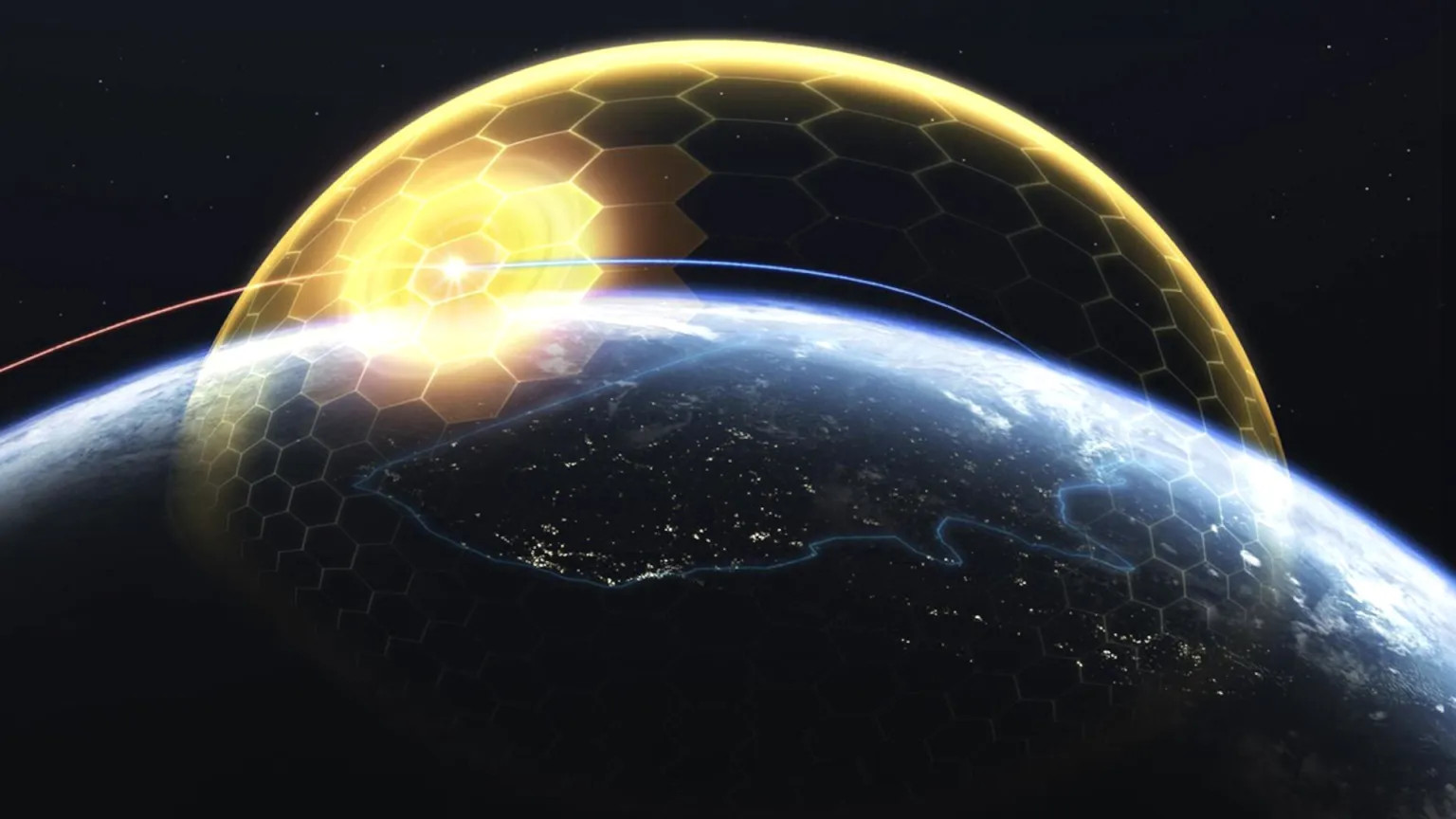
“We’re basically responding to a warfighting domain where our adversaries have already put interceptors in space, and we want to make sure that we rebalance that in terms of deterrence,” Saltzman said more recently in response to a question from our Howard Altman at a roundtable on the sidelines of the Air & Space Forces Association’s (AFA) annual Warfare Symposium in February.
“Interceptors by definition refer to a handful of well-acknowledged capabilities that other countries have, like ground and air-launched anti-satellite missiles or capabilities like the SJ-21, which has a grappling arm,” a Space Force spokesperson later clarified to TWZ when asked for further details about the “interceptors in space” Saltzman had mentioned.
This all highlights the very real prospect of actual fighting in space during future conflicts, something the U.S. military is increasingly preparing for, as you can read about more here. What would be necessary to protect 7,800 anti-missile interceptors in orbit, as well as critical associated space-based sensors and communications constellations, could easily add to Golden Dome’s total cost.
As CBO makes clear in its latest assessment, much is still unknown publicly about the actual scale and scope of Golden Dome, and what it might therefore cost in the end. At the same time, space-based interceptors are a very real part of the planned architecture, with work underway now to develop those capabilities.
The concept that CBO has outlined already involves an extreme expenditure of money and resources, all for a capability it still assesses to be useful only against relatively limited barrages from rogue states. Those are threats that could well be addressed using far less expensive surface-based systems, though not ones that can intercept targets in their boost phase.
As underscored now by CBO’s latest cost projection, a relevant constellation of interceptors in space remains likely to be the most costly and complex aspect of Golden Dome, if it comes to fruition at all.
Contact the author: joe@twz.com
editor's pick
latest video

news via inbox
Nulla turp dis cursus. Integer liberos euismod pretium faucibua