
Pentagon’s Mindset On E-7 Radar Aircraft It Tried To Axe Has Completely Changed: Hegseth
The Pentagon says it is working to amend its proposed Fiscal Year 2027 budget to request new funding for E-7 Wedgetail airborne early warning and control aircraft to replace the U.S. Air Force’s aging E-3 Sentry jets. The original version did not ask for any money for E-7, which had raised the prospect of a new fight with Congress over the future of the program. Legislators intervened earlier this year to reverse a previous attempt to axe the Wedgetail. Secretary Pete Hegseth, previously a chief advocate for the cancellation, says his Department’s “mindset” has now fundamentally changed.
Rep. Tom Cole, an Oklahoma Republican, asked Hegseth for an update on the E-7 during a hearing before members of the House Appropriations Committee earlier today. In his question, Cole, who is Chairman of the committee, also highlighted the loss of one of the Air Force’s existing E-3s, also known as Airborne Warning and Control System (AWACS) aircraft, in an Iranian attack on Prince Sultan Air Base in Saudi Arabia in March. That has put new emphasis on the Wedgetail program. The latest conflict with Iran has also just added to the already significant strains on the dwindling fleet of aging E-3s, as TWZ has previously explored in detail.
“Let me ask you a specific question, and you may want to get back to me on this, I don’t know, but we’ve had some discussion over – you know, we lost one E-3. On the ground, thank goodness. Looks like no crew loss,” Rep. Cole said, leading into his question. “This committee has been interested in investing in the E-7. The Pentagon signed the contract for five additional planes. [It is] not in the Air Force budget [for Fiscal Year 2027]. Is there going to be a fix to that? Where are we at on thinking about the E-7?”
As of April, the Air Force had awarded contracts to Boeing for a total of seven developmental E-7s. Versions of the Wedgetail are already in service in Australia, South Korea, and Turkey. The United Kingdom is also set to field a fleet of these aircraft. However, a U.S.-specific configuration is now in the works.

“I am well aware of that dynamic. I know our department had taken the position that it was … other satellite ISR [intelligence, surveillance, and reconnaissance capabilities] that was probably going to be capable of a lot of that in the future,” Hegseth said in response to Rep. Cole’s question. “But I think that mindset was indicative of a mindset that we’ve shed, which is the divest-to-invest mindset, which was an austerity mindset, that we’re going to get continuing resolution after continuing resolution. So, we [sic] got to get rid of these platforms in order to invest in these platforms. And there are gaps that need to still be filled. And there are systems that still need to be funded that are used on the battlefield right now, say, MQ-9s, A-10s, you name it.”
“And the E-7 is one of those,” Hegseth continued. “So, we’ve actually sent a budget amendment to OMB [the Office of Management and Budget at the White House] to add that. I think it has a future. It has a place on the battlefield. And we’ll get more information for you on that, as well.”
The continuing resolutions referenced here are short-term federal government spending packages that Congress routinely approves when it cannot pass a full annual budget.
Secretary Hegseth also touched on the Air Force’s long-term plan, which remains unchanged publicly, to eventually push most, if not all, air moving-target indicator (AMTI) tasks into orbit. His comments today implicitly acknowledge that cancelling the E-7 program would have risked a serious capability gap in the near term, with the hopes of a better solution coming in the future. This is something TWZ had been sounding the alarm on since last year. Despite major investments and prototyping activities already underway, those space-based capabilities are still years away, at best, from becoming a reality. The Air Force’s original plan to replace a portion of its E-3 fleet with E-7s underscored the expectation that airborne early warning aircraft would also continue to play a vital role for years to come.
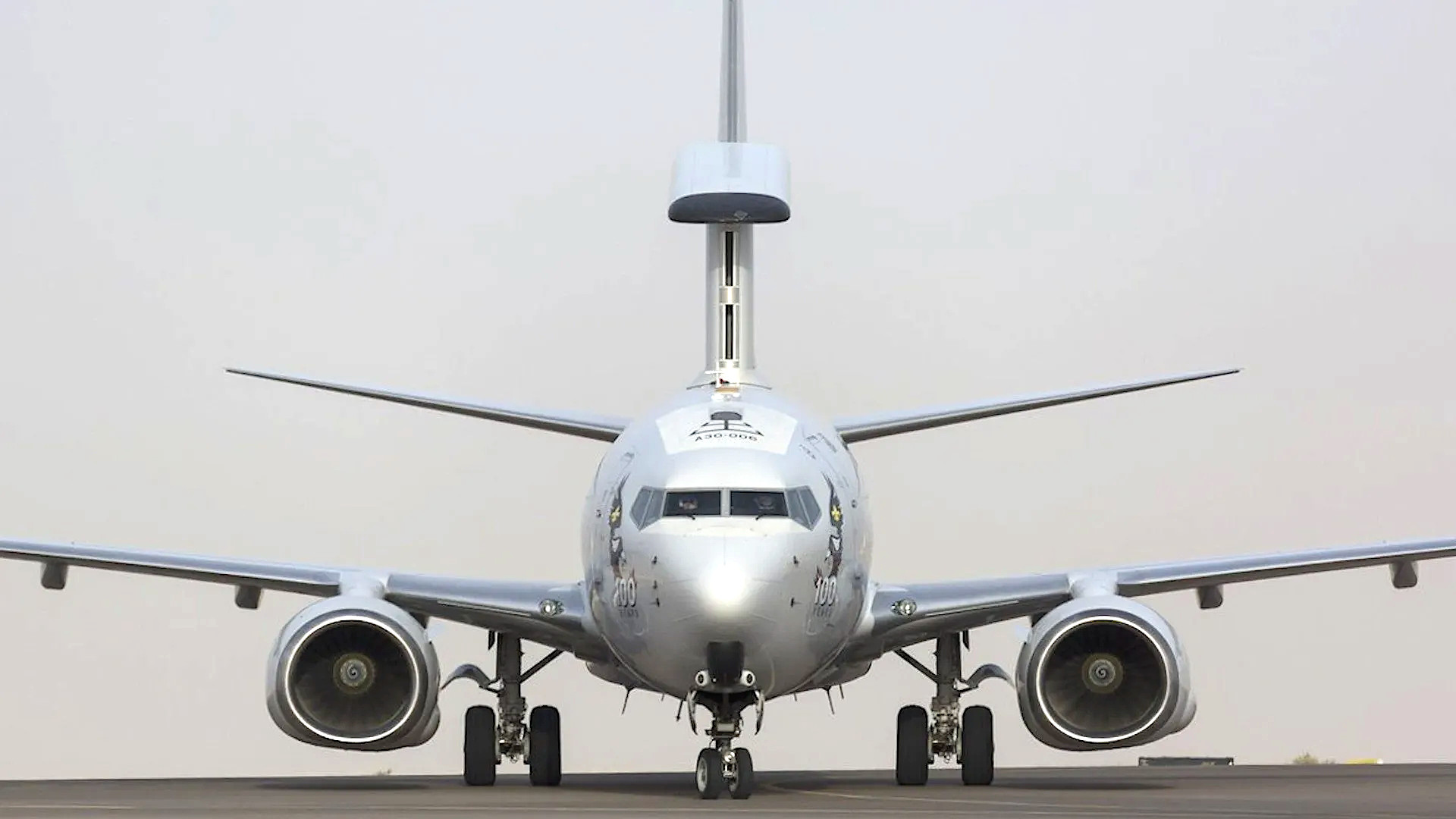
As a replacement for the E-3, the E-7 is a much more modern and capable aircraft. The Wedgetail is arguably the best airborne look-down sensor platform anywhere in the world at present, which is especially valuable for spotting long-range kamikaze drones, as well as cruise missiles. The Boeing 737-based design is also adaptable to other mission needs, including battle management and serving as a networking node using its own expansive communications and data-sharing suite. TWZ highlighted all of this in March, when Australia announced it was sending one of its E-7s to the Middle East to help Gulf Arab States defend against Iranian attacks.

Northrop Grumman MESA Radar – Boeing E-7 AEWC
Hegseth’s comments today on the change in mindset at the Pentagon do not touch on the argument that he and others made last year that year, that the E-7 was too vulnerable to be viable in future conflicts. This was despite an accompanying plan for the acquisition of more of the E-2D Advanced Hawkeyes that the U.S. Navy currently flies to fill airborne early warning capability gaps in the absence of an Air Force Wedgetail fleet. TWZ and others had quickly pointed out that the same survivability questions applied equally to the E-2D, which is also not as capable an aircraft as the E-7, as you can read more about here.

When previously arguing for its cancellation, Hegseth and others had also cited cost overruns and delays that had befallen the Air Force’s Wedgetail program since it first kicked off back in 2022.
As noted, Congress had interceded to save the E-7 from purgatory, at least in Fiscal Year 2026, appropriating more than $1 billion in new funding for the program. Of the seven Wedgetails the Air Force has on order now, five were put on contract just this past March. The service had previously ordered two other jets to support rapid prototyping efforts. Even so, the Air Force had continued to sound somewhat noncommittal about the future of the E-7 program.
“We, of course, as we always do, follow congressional direction, and we will do the [E-7] rapid prototypes. We will fund those rapid prototypes,” Secretary of the Air Force Troy Meink told TWZ and other outlets at a roundtable on the sidelines of the Air & Space Forces Association’s (AFA) annual Warfare Symposium in February. “They told us to deliver a plan for additional aircraft. Now we will do that.”
“By the way, ‘deliver a plan’ does not mean we’re going to put it in the budget,” Meink also said at that time. “We will deliver a plan of what it takes to do it, and then we’ll have a discussion with them [Congress].”
This is what turned out to be the case, at least initially, with the E-7 again being absent from the Air Force’s proposed 2027 Fiscal Year budget when it was rolled out in full last month.
“The Department [of the Air Force] is committing to work with you to figure out how to adjust the [20]27 budget submission to fund the E-7, and then work the [20]28 [budget] going forward,” Meink said at a separate hearing more recently, according to Air & Space Forces Magazine.
Despite the Pentagon saying its position on the E-7 has now completely changed, when the Air Force might begin flying the jets operationally remains to be seen. The service’s original goal was to have Wedgetails flying real-world missions in 2027, but the schedule had already slipped to 2032 by the beginning of last year. Though it is back underway now, the program was effectively frozen for much of 2025, which could easily have set the timeline back even further. Steps could also now be taken to try to accelerate the acquisition and fielding of the aircraft.
In the meantime, the E-3 fleet, which has already shrunk dramatically in recent years, continues to struggle to meet operational requirements. Demand for AWACSs has now surged further due to the latest conflict with Iran. As noted, the Iranians also destroyed one of these prized aircraft in March. The Air Force has said that it is looking into replacing various aircraft lost in the fighting with Iran so far, but it is unclear if this will include regenerating a previously retired Sentry from storage. That would be a long and costly process, but there is no other realistic source available for a replacement E-3, the very last of which were delivered in the early 1990s.
As it stands now, the Pentagon and the Air Force look to have fully dropped their opposition to moving ahead with fielding the already sorely needed fleet of new E-7s.
Contact the author: joe@twz.com
editor's pick
latest video

news via inbox
Nulla turp dis cursus. Integer liberos euismod pretium faucibua