Breitbart Business Digest: Jerome Powell, Will You Please Go Now?
The Weekly Wrap: A Chair Who Wouldn’t Take a Seat, the Boom They Couldn’t Hide, and the Saint They Couldn’t Burn
Welcome back to Friday. This is the Breitbart Business Digest weekly wrap, where the week is traditionally brought to an end but is being extended for a certain period TBD in order to protect the independence of newsletter policy. It’s the foundation on which our economy is built!
This week, Jay Powell told us that we can take the Fed chair away from him, but we can’t take him away from the Fed. The greatest untold story of 2026—the U.S. manufacturing boom—finally got told. And the stock market decided to eat the bears for breakfast.
Powell’s Fed 4-Eva!
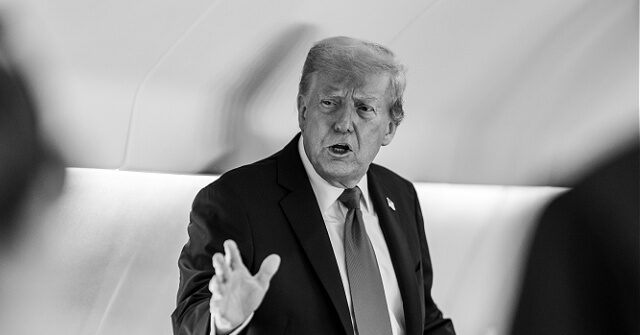
It looks like we’ll still have Jay Powell to kick around for at least a few months longer. The outgoing Fed chairman really did it: he broke with 113 years of Fed precedent and decided to stay on the Fed board and the Federal Open Market Committee until…well, that’s not exactly clear. In his own words, it is “TBD.”
Powell’s term as governor lasts through January 2028. We doubt he wants to stick around that long. In fact, he’s likely to discover that it is much less fun being a Fed governor than a Fed chair, at least once you’ve been the chair. We expect that when Kevin Warsh is confirmed, Powell will be treated with all due respect. But would it really be that bad to put Powell in an inconvenient office or move his parking spot under the tree that’s popular with the local avifauna?
Powell argued that he is staying on to preserve the independence of the institution of the Fed rather than out of a personal animus against Trump. That’s not really plausible. Each member of the current roster of Fed governors and Fed presidents has demonstrated unflinching support for Fed independence. Why would Powell be the linchpin? What’s more, anyone Trump nominates to replace Powell on the board would have to win confirmation from the Senate, and the Tillis-Pirro affair demonstrated that the Senate would also not let Fed independence crumble.
Powell appears to have what the kids these days call “main character syndrome.“ He’s convinced that this story is about him. And that the future of the Fed—and the entire American economy—depends on his choices. That conviction may actually be a good reason to reform the Fed to reduce the chair’s influence. Certainly, a lot that has happened over the past six years—especially the disastrous accommodation of Joe Biden’s reckless woke Green New Deal spending spree—was heavily influenced by Powell. But the narcissism it appears to have created is regrettable.
Our guess is that Powell will not step away until the Supreme Court delivers its verdict in the Lisa Cook case. You’ll no doubt recall that Cook is the Fed governor Trump sought to remove last year and whom Powell—and therefore the institution of the Fed—backed to hold on to her seat. But Powell may also stick around until after the midterms, hoping that his replacement would have to be confirmed by a Democrat controlled Senate.
Whether he knows it or not, Powell’s real motivation here is likely to control the narrative of his legacy. His tenure as Fed chair is full of errors, some much worse than others. Under his watch, the Fed has had more ethics scandals, as evidenced by a high number of resignations, than under any other Fed leader. Powell over-tightened in Trump’s first term, apparently convinced by central bank analysts that the economy was growing too fast. He adopted the idea of average inflation targeting, which proved a bust and contributed to the Bidenflation disaster. He allowed the mission to drift into DEI. He accommodated the Biden spending, keeping interest rates way too low for too long. He declared inflation transitory. He cut rates on the eve of the 2024 election. He very publicly took the position that tariffs would be inflationary in the short term.
It’s not a pretty record—certainly not the thing you want your grandkids to read in their AP U.S. History textbooks. So, Powell has decided that he’ll try to reframe his time at the Fed as a fight for the independence of the central bank and a fight against Donald Trump. Better historians will no doubt record the affair as an egomaniacal crusade.
The U.S. Manufacturing Boom
A week ago, respectable people were starting to acknowledge what they called a hidden or unsung manufacturing boom in the United States. This week it came out of hiding. Durable goods orders rose 0.8 percent, smashing through the already elevated expectation for a 0.5 percent increase. Core capital goods soared 3.3 percent. That would be a good year. To see it in a month is almost unbelievable. New orders for electronic equipment rose 3.7 percent.
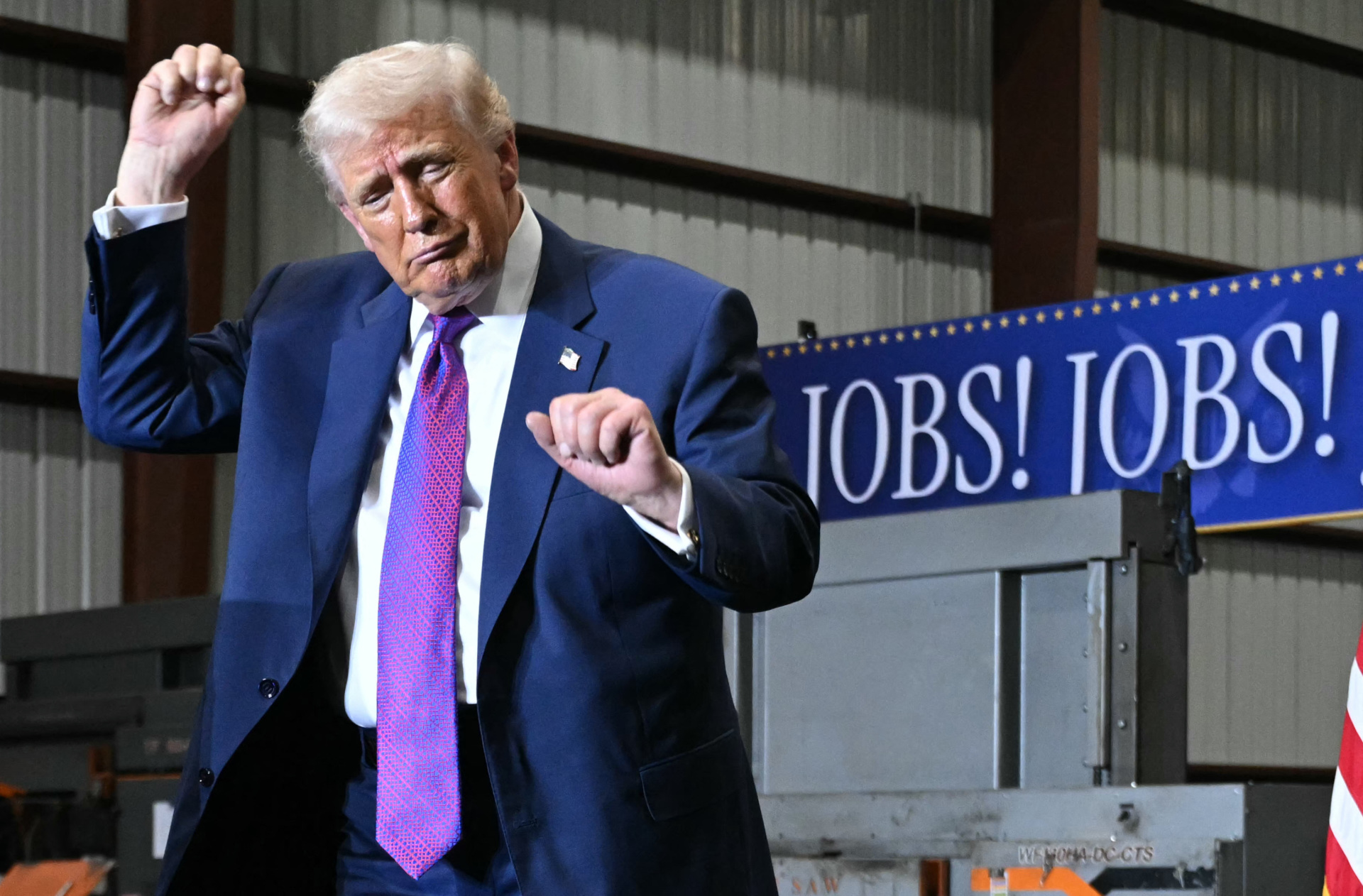
President Donald Trump dances at the end of his speech after touring the Coosa Steel Corporation factory in Rome, Georgia, on February 19, 2026. (SAUL LOEB/AFP via Getty Images)
The GDP figures for the first quarter also showed evidence of the manufacturing boom. Gross private investment in non-residential fixed investment soared at an annual pace of 10.4 percent. Within fixed investment, equipment investment jumped 17.2 percent, and intellectual property product investment climbed 13.0 percent.
This is quite obviously related to the AI adoption buildout. But don’t dismiss the role of Trump policy here—and the role of the spirit of economic nationalism. Trump’s tax cuts, especially the full cap-ex depreciation rules, are facilitating this investment bonanza. His tariffs have cajoled companies into building here rather than abroad, and to build using U.S.-made equipment and components and U.S. labor. And the belated realization that national security concerns and long-term economic interests of investors and businesses require domestic production has helped. Also, American businesses are finally aware of the dangers posed by reliance on Chinese manufacturing.
The old phrase from Field of Dreams was: If you build it, they will come. In Trump’s America, we’re building it again, and the too-long dormant spirit of American economic dominance is returning.
April is the Cruelest Month—for Bears
A lot of our friends who are still bearish on the U.S. economy—the bears are not all TDS liberals, for what it is worth—were convinced that the war in Iran presaged ruin for the U.S. economy. This was not a completely implausible argument. High energy prices tend to drain spending from other parts of the economy, all other things being equal. Consumer sentiment was being dragged unconscious across the firmament even before the war and the closing of the Strait of Hormuz. Hiring has been bumpy (although we think that’s a lot less of a problem since we’re at full employment).
Still, we kept repeating our mantra: Panickers Always Lose Money. PALM. And the market decided the argument in our favor. April was the best month for stocks since the announcement of the vaccine in 2020. On May 1, the S&P hit a new record, and the Dow is flirting with its record high. And this isn’t evidence of some sort of unsustainable mania: corporate earnings have been spectacular and forward guidance very strong. As our friend Larry Kudlow likes to say, profits are the mother’s milk of stocks.
To protect the innocent and the guilty, we’re not going to name names here. But, come on, guys. It’s time to hang up the bear suits.
The Fire This Time
This Monday is the feast of St. Florian, the Roman military officer who organized firefighting brigades in the province of Noricum, which is modern-day Austria. He was subsequently martyred under Diocletian around 304 A.D. Legend holds that he once extinguished a raging fire with a single bucket of water. He has been the patron saint of firefighters since the twelfth century, and May 4 was chosen as International Firefighters’ Day in his honor.

Statue of Saint Florian by Anton Pfaffinger, 1734, located in the Old Marketplace in Salzburg, Austria. (DeAgostini/Getty Images)
Florian is at the center of a legal battle in Quincy, Massachusetts, where Mayor Thomas Koch commissioned two ten-foot bronze statues of St. Florian and St. Michael the Archangel (the patron saint of police officers) for the facade of the city’s new $175 million public safety building. But this is America, where the money says “In God We Trust,” but public officials aren’t allowed to openly agree. So, Koch, a practicing Catholic, has to say he chose the figures to honor first responders, not to promote religion—not that that did him any good.
The ACLU of Massachusetts caught wind of the plans and ran off to state court to prevent the installation of the statues. A trial court judge sided with the ACLU, apparently on the grounds that adorning a building with depictions of saints is akin to establishing a state religion. So, the statues are sitting in a warehouse somewhere outside Boston. The hope is that they’ll be freed by a higher power, either the Massachusetts Supreme Court or the Supreme Court of the United States.
St. Florian was a soldier who ran toward the fire in the name of the Highest Power. When Diocletian got word that Florian was refusing to kill Christians in Noricum, he sent Governor Aquilinus to investigate. To test his faith, the governor ordered Florian to make sacrifices to the Roman gods. Florian refused and openly declared himself a Christian, so Aquilinus sentenced him to be beaten and then burned. When Florian’s soldiers refused to light the pyre, Florian told them to have courage and set the thing ablaze, declaring that he would climb the flames to Heaven. The governor freaked out and, not quite understanding how ascent to heaven works, he had Florian beaten, flayed, and then drowned with a millstone around his neck, presumably on the theory that if Florian didn’t climb flames, he’d never get to Paradise.
Seems like Quincy should be allowed to honor the men and women who run toward their fires with a bronze sculpture of the guy. In opposing it, the ACLU reminds us that they are on the side of the flames, the millstones, and the Grand Adversary behind the actions of Diocletian and Aquilinus.
editor's pick
latest video

news via inbox
Nulla turp dis cursus. Integer liberos euismod pretium faucibua