This post was originally published on this site.
Secretary of War Hegseth Declares End of Free Ride for Allies at the Shangri-La Dialogue
This post was originally published on this site.
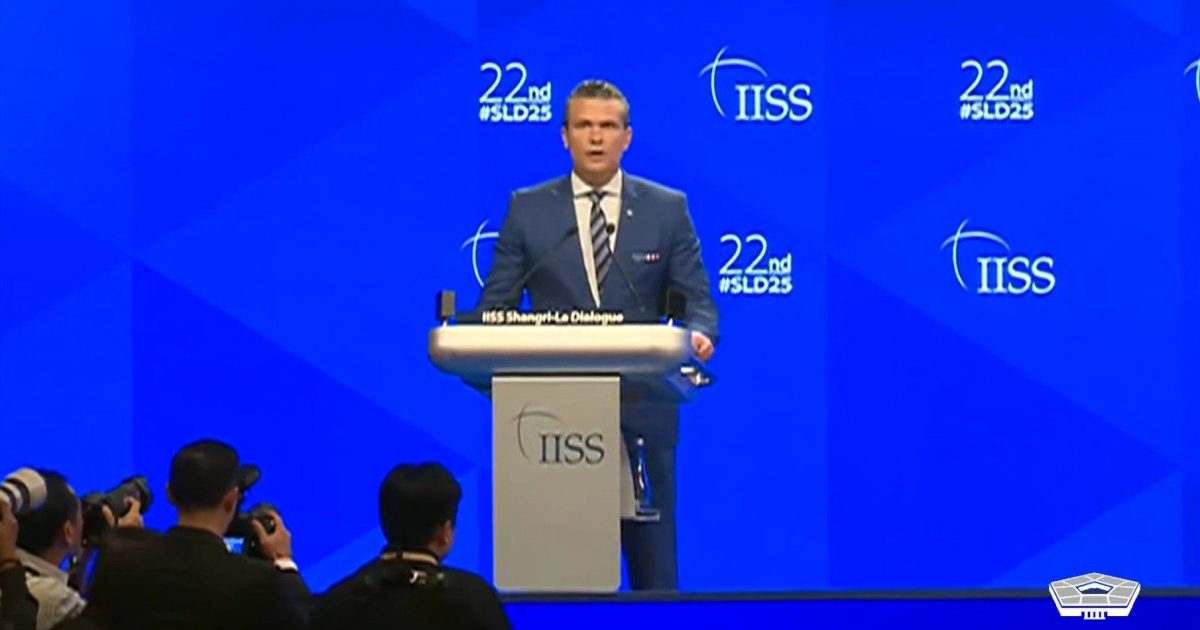
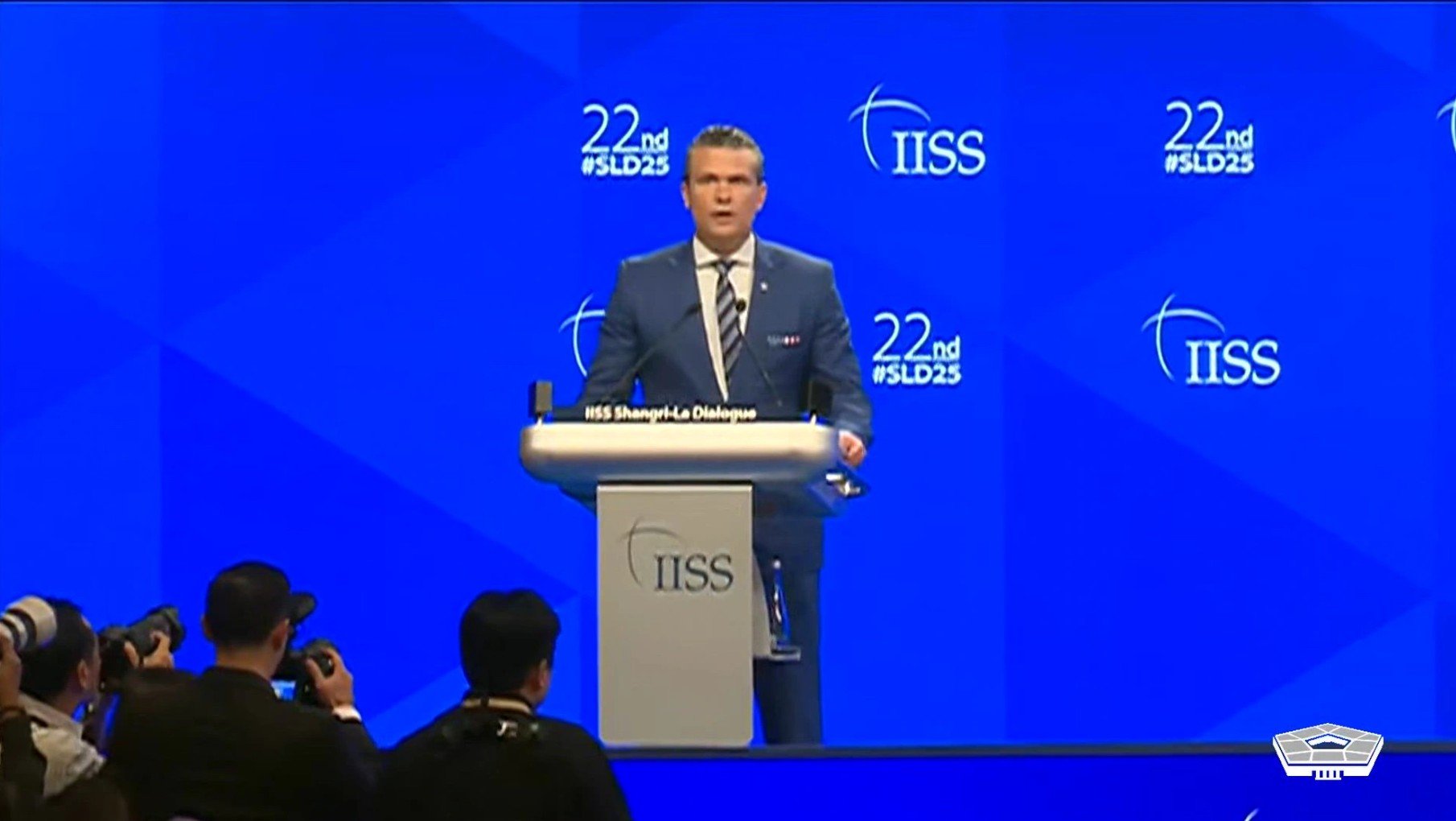
“The National Defense Strategy makes clear that the old toothless, utopian, and globalist course of foreign policy was headed for a disaster that all changes under President Trump,” Secretary of War Pete Hegseth told a group of international defense ministers, military chiefs, diplomats, and analysts at the Shangri-La Dialogue. The event, held each year in Singapore, is Asia’s premier annual defense summit and is organized by the International Institute for Strategic Studies (IISS).
Hegseth delivered the opening plenary on May 30, building his speech around three principles: defending the U.S. homeland and the Western Hemisphere, countering China, and demanding that allies become more self-reliant in defense by assuming a greater share of their own security responsibilities rather than depending on the United States.
The 2026 National Defense Strategy is cited as the doctrinal foundation. The phrase “strong, quiet, and clear” repeats throughout as the operational motto of the Trump administration’s Pacific posture, a deliberate inversion of the loud-protest, weak-follow-through approach he attributes to prior administrations. In a nod to Theodore Roosevelt, Hegseth promised U.S. allies and foes alike that “what the United States delivers is strength that is disciplined, resolve that is steady, and leadership that is confident enough to speak and walk softly while carrying a big stick.”
Hegseth explained how the Trump administration had refocused the mission of the United States Armed Forces. “We will prioritize lethal capabilities, strategic discipline, and businesslike cooperation over empty rhetoric and peacocking.”
Mainstream media claimed that he took a reserved tone toward Beijing, but this is inaccurate. He had already mentioned the China threat within the first few minutes of his speech. “We insist that China respect our longstanding position in the region, and not just insist, but maintain the manifest military strength to underwrite it.”
Just as in the 2026 National Defense Strategy, the framing of the China threat and how to address it has changed. The United States is now prioritizing the homeland and the Western Hemisphere against all threats. Hegseth said, “Under the leadership of President Trump, who has over the past year shown repeatedly what it means to defend American national interests, from Nicolas Maduro in Venezuela to Midnight Hammer to cartel drug boats to Epic Fury. We have restored a proactive and realistic approach to our own national defense, reestablishing deterrence.”
Hegseth went as far as to say, “Now we are reestablishing the Monroe Doctrine, the Donroe Doctrine, as I like to call it, in the Western Hemisphere, aggressively defending our homeland and our hemisphere. We will protect our people.”
The improved diplomacy between the U.S. and China following the recent Trump-Xi meeting has been characterized by the press as a policy failure or capitulation. Hegseth, however, pointed out that there has been no capitulation. President Trump is pursuing policies that prioritize U.S. interests over those of all other nations, including China.
At the same time, improved communication can help prevent violence. “By maintaining open lines of military-to-military communication, we can coordinate, deconflict, and reduce the risk of miscalculation.”
Hegseth described his role this way: “Now, all of that said, my job at the United States Department of War is to provide the military strength to support President Trump’s visionary and realistic diplomacy.”
The press was quick to point out that he did not mention Taiwan specifically. However, the secretary’s position on containing China in the Pacific was clear. “We will build and sustain a strong denial defense in the Western Pacific that ensures aggression is infeasible, escalation unattractive, and war deemed irrational.”
This was where he began to transition to the need for other countries to do their part, and the end of countries freeloading on American military protection. “We seek alliances built on shared responsibility, not dependency.” He also said that “A favorable balance of power requires capable allies with real military strength, real industrial capacity, and real political resolve. For too long, the security of this region has rested disproportionately on American military power.”
Hegseth worked through nearly every major Pacific partner by name: South Korea, Philippines, Japan, Australia, Singapore, Indonesia, Malaysia, Thailand, Vietnam, and India, grading each on defense investment and interoperability. The framework was explicit: nations meeting the 3.5% GDP defense spending standard get moved to “the front of the line” for arms sales, intelligence sharing, and industrial collaboration.
Those who do not are told their free-riding days are over. South Korea was held up as the model, with President Lee’s commitment to 3.5% singled out for praise. His core line: “We need partners, not protectorates. Alliances are not judged by the number of flags, but by the number of formations. We don’t need more conferences. We need more combat power. I’m sorry to say this here: less Shangri-La, more ships, more subs.”
He concluded with a strong and Christian message. “Those who long for peace must prepare for war…The challenges we face are real, but so is the opportunity before us. We must meet that moment, and may Almighty God bless all of our troops in harm’s way.”
The post Secretary of War Hegseth Declares End of Free Ride for Allies at the Shangri-La Dialogue appeared first on The Gateway Pundit.
editor's pick
latest video

news via inbox
Nulla turp dis cursus. Integer liberos euismod pretium faucibua