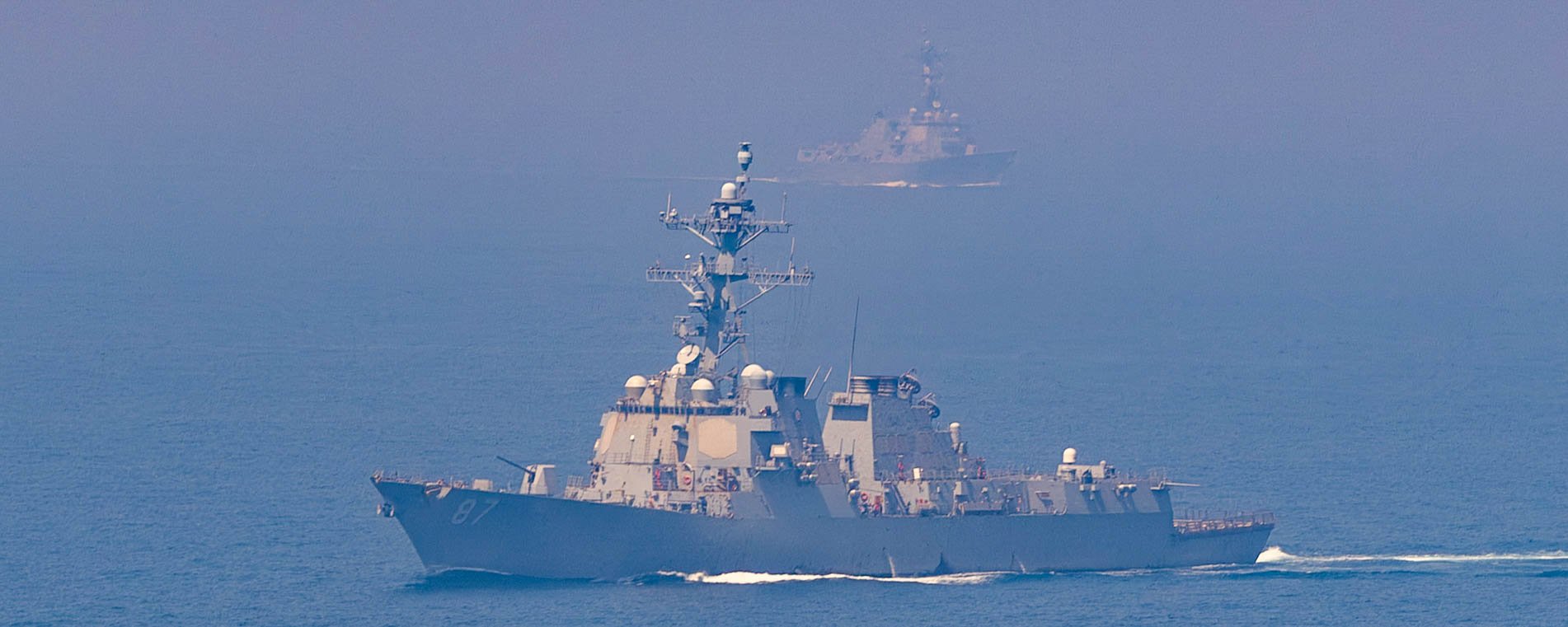
IRGC Navy Claims Vast Expansion In Its Definition Of Strait Of Hormuz
The Islamic Revolutionary Guards Corps (IRGC) Navy claims it has greatly expanded how it defines the Strait of Hormuz, which it has closed to most shipping since the start of the now-paused war. The move comes as that closure has wide-ranging impacts on the global economy and with U.S. President Donald Trump mulling new military actions against Tehran amid deadlocked peace negotiations and a tenuous ceasefire barely holding.
Under its new definition, the IRGC claimed a tenfold expansion “forming a complete crescent” of “about 20 to 30 miles to one now over 200 to 300 miles,” Political Deputy of IRGC Navy Mohammad Akbarzadeh said in a TV interview, according to the official Iranian FARS news agency.
“The Strait is no longer viewed as a narrow stretch around a handful of islands but instead has been greatly enlarged in scope and military significance,” Akbarzadeh noted. “In the past, the Strait of Hormuz was defined as a limited area around islands such as Hormuz and Hengam, but today this view has changed. The Strait is now defined as a strategic zone stretching from the city of Jask in the east to Siri Island in the west.”
We asked the White House and CENTCOM for reactions to the IRGC Navy announcement. The White House dismissed it.
“During Operation Epic Fury, Iran was crushed militarily – their ballistic missiles are destroyed, their production facilities are dismantled, their navy is sunk, and their proxies are weakened. Now, they are being strangled economically by Operation Economic Fury and losing $500 million per day thanks to the United States Military’s successful blockade of Iranian ports,” White House Deputy Press Secretary Anna Kelly told us. “The Iranian regime knows full well their current reality is not sustainable, and President Trump holds all the cards as negotiators work to make a deal.”
CENTCOM has not responded to our query.
The reported expansion is the second announced by Iran since the start of its conflict with the U.S. and Israel.
The IRGC did not specify what actions it would take in under its expanded definition. However, while the vast majority of Iran’s naval forces have been destroyed during Epic Fury, it has been attacking ships in the region with cruise missiles, drones and its fleet of small attack boats that remains largely intact. In addition, Iran has reportedly continued mining the Strait even after the April 7 ceasefire.
Both U.S. Central Command (CENTCOM) and Iran say the IRGC launched strikes against U.S. Navy warships and commercial vessels they were helping to protect during the short-lived Project Freedom on May 4. That was an effort, created by Trump, to help guide ships through the Strait that was paused after about 36 hours. CENTCOM forces responded with strikes on attacking ships. Days later, another exchange of fire took place, with CENTCOM saying it bombed targets Iranian targets after destroyers came under fire transiting the Strait to the Gulf of Oman.
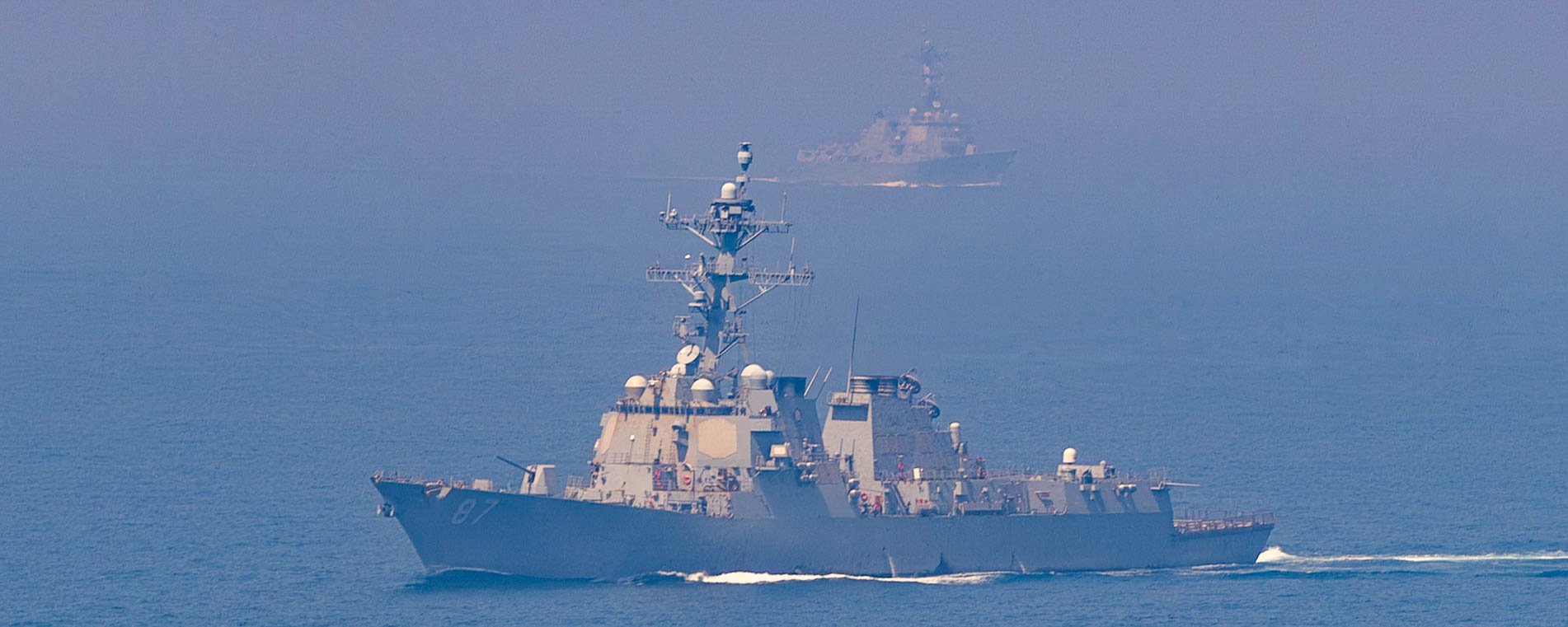
Meanwhile, the Navy has disabled four Iranian vessels trying to run the ongoing blockade.
The IRGC said the new definition was created in response to yesterday’s statements by President Donald Trump repeating that Iran’s Navy has been destroyed by U.S. attacks during the now-paused Operation Epic Fury.
“This very design and implementation of the new plan shows that this force is present on the scene with authority,” Akbarzadeh proffered.
As we noted yesterday, frustrated by the pace of negotiations, Trump threatened new military action against Iran ranging from resuming Project Freedom to new airstrikes against Iranian targets and perhaps even a ground incursion to retrieve Iran’s highly enriched uranium.
The closure of the Strait is having a direct impact in the U.S., spurring Trump to consider pausing the federal gas tax as a form of relief for American consumers as energy prices soar, The Washington Post noted. The move — which requires congressional approval to pass — would mark the latest in a string of government interventions to address fallout from the war.
“Since the war began in late February, the price of a barrel of Brent crude oil, an international benchmark, has skyrocketed from about $70 to more than $107. U.S. gas prices — now an average of $4.50 a gallon — have reached levels not seen since 2022 and contributed to Trump’s falling approval ratings ahead of the November midterms,” the Post stated.
The impacts of the closure are even greater in Asia, which relies more heavily on oil that normally transits the Strait. For instance, Indian Prime Minister Narendra Modi asked his nation’s 1.4 billion people to spend less on fuel, fertilizer, and travel, The New York Times reported.
Modi “made these sweeping recommendations in a national address on Sunday after securing a big win for his party in recent state elections,” the newspaper added. “With that victory in hand, he no longer has to worry that voters might punish his candidates for higher prices of fuel, food and transport, which are tightly controlled by India’s government. Instead of subsidizing the losses and running huge budget deficits, India’s leader appears emboldened to ask its people to bear the burden.”
The situation is so dire that the International Energy Agency has recommended a range of measures for governments and businesses to reduce demand and mitigate the “oil shock,” CTech reported.
“Among the proposals: encouraging remote work and reducing commuting, which accounts for between 5% and 30% of vehicle use,” according to the publication. “Road transport alone represents about 45% of global oil demand. According to the agency, if the average employee worked from home three days a week, personal oil consumption could fall by as much as 20%.”
Several countries have already adopted such policies, CTech noted.
“Indonesia now requires public-sector employees to work remotely on Fridays, while Myanmar mandates remote work on Wednesdays. Pakistan and the Philippines have introduced four-day work weeks for government employees, while Sri Lanka, Peru, and Bangladesh have shortened school weeks or expanded distance learning.”
Meanwhile, the longer the Strait remains closed, the greater the impact on the global economy. Though Trump continues to insist his bottom line on ending the conflict is ensuring that Iran never gets a nuclear weapon, the Strait of Hormuz remains the most urgent flashpoint.
UPDATES
The war has cost U.S. taxpayers $29 billion so far, Jay Hurst, Pentagon comptroller, told lawmakers this morning. That’s up from the $25 billion estimate he provided Congress on April 30. These estimates mostly take into account the amount of munitions the U.S. has expended during Epic Fury. They do not include the cost to repair damage to U.S. military installations across the Middle East, Hurst again noted today.
That means the price tag for Epic Fury will be far higher than what Hurst told Congress.
In addition to 14 troops who have been killed so far, several media reports have pointed out that the damage to U.S. assets has been far more extensive than officially reported. Last week, for instance, a Washington Post analysis “found 217 structures and 11 pieces of equipment that were damaged or destroyed at 15 U.S. military sites in the region.”
A new attack on Iran could spur the country to pursue weapons-grade enrichment of its uranium, an official in Tehran threatened on Tuesday.
“One of Iran’s options in the event of another attack could be 90%enrichment,” Ebrahim Rezaei, a member of the Iranian parliament and the spokesperson for the body’s National Security and Foreign Policy Commission, stated on X. “We will review it in the parliament.”
As we previously noted, the International Atomic Energy Agency (IAEA) reported that Iran had a stockpile of close to 901 pounds, at least, of uranium enriched to 60% purity, which presents clear proliferation concerns.
The 60% enrichment level is well above what is required for civilian power generation (typically between 3% and 5%), but also below the level for it to be considered highly enriched or weapons-grade (90%). At the same time, it is understood to be a relatively short step, technically speaking, to get uranium from 60% to 90% purity. As a standard metric, the IAEA says that 92.5 pounds of 60% uranium is sufficient for further enrichment into enough weapons-grade material for one nuclear bomb.
However, it is one thing to threaten to boost enrichment and another thing to actually do it. Sites that would have traditionally been used to do this are now largely destroyed. What’s left of them is heavily surveilled by the U.S. and any strong indication that such a move was taking place would likely result in a new wave of strikes from the U.S. and especially Israel.
U.S. Ambassador to Israel Mike Huckabee publicly confirmed that Israel sent the UAE an unspecified number of Iron Dome air defense batteries and troops to operate them. News of the deployment was first reported by Axios last month.
“Can I say a word of appreciation, deep appreciation and admiration for the United Arab Emirates?” Huckabee said during an event in Tel Aviv on Tuesday. “I think that the UAE is an example. They were the first Abraham Accord member, but look at the benefits that they have had as a result. Israel just sent them Iron Dome batteries and personnel to help operate them. How come? Because there’s an extraordinary relationship between the UAE and Israel.”
Huckabee added that in the days after the Oct. 7, 2023 Hamas surprise attack on Israel, the UAE was the only nation maintaining flights to Israel while U.S. and European carriers stopped.
Iran’s ambassador to the United Kingdom and permanent representative to the International Maritime Organization (IMO), Ali Mousavi, issued a formal complaint about the U.S. interdictions of Iranian oil tankers M/T Tifani and Majestic X, Iran’s official IRNA news outlet reported.
“In a letter to IMO chief Arsenio Dominguez on Monday, Mousavi referred to the dire conditions of the crew members of the two seized tankers, warning that Washington is responsible for the lives and health of the sailors caught in the situation,” the outlet claimed.
In the letter, “Mousavi stated that about 60 crew members of the two tankers, including 20 Iranian nationals, are being held on a tugboat in unsafe and unhealthy conditions, reportedly without adequate food and water to those on board.”
Mousavi called the situation “intolerable and a clear violation of the relevant rules and regulations of the IMO, stressing that any unilateral US claim has no legal justification for exposing civilian seafarers to starvation, deprivation and danger on the high seas,” IRNA noted. “He described the US behavior as illegal, reckless, inhumane and completely inconsistent with the basic standards governing the treatment of persons employed in commercial shipping.”
TWZ cannot independently verify that claim. CENTCOM declined comment.
In the wake of French Tiger attack helicopters shooting down Iranian drones attacking the UAE in March, France is now considering embarking these aircraft aboard frigates for any potential Strait of Hormuz security effort.
“The French Army’s Tiger helicopter was tested last March in the United Arab Emirates; equipped with its 30mm cannon and two pods carrying 22 rockets, it proved to be truly effective—and a powerful deterrent—against Iranian drones,” French Navy Admiral Thibault de Possesse, commander of the Charles de Gaulle carrier strike group now in the Red Sea, told the RFI media outlet.
“Recently—thanks to the efforts of the DGA [Directorate General of Armaments], as well as those of the Navy and the Army—we have certified the deployment of Tiger helicopters aboard French Navy frigates,” de Possesse explained. “Consequently, we are now capable of launching and recovering these combat helicopters—which are armed and specifically adapted for drone interception—directly from Navy frigates. They have already demonstrated their effectiveness against this type of threat in the United Arab Emirates.”
The Israeli Air Force intercepted a drone “launched from the east,” for the first time since the ceasefire with Iran took effect, the IDF said.
It remains unclear whether the drone was launched from Yemen or Iraq, as launches from both countries have been described in the past by the IDF as “from the east,” noted I24 reporter Ariel Oseran.
Soar Atlas has released new high-resolution imagery it claims shows a clear view of a clandestine airstrip Israel built in western Iraq. The existence of the airstrip was first reported by The Wall Street Journal, which stated it was set up to aid Israel’s air war on Iran in the now-paused war. The facility housed special forces and served as a logistical hub for the Israeli air force, the newspaper noted. Built with the knowledge of the U.S. just before the start of the war, it also included search-and-rescue teams positioned to assist any downed Israeli pilots.
The Soar Atlas images were taken March 8 and appear to show the airstrip constructed on a dry lake bed near al-Nukhayb in Iraq’s Anbar Desert during the opening days of the Iran war.
“The improvised runway, measuring approximately 850 meters in length, was reportedly built overnight between March 1–2, 2026,” according to Soar Atlas.
As we noted yesterday, the Iraqi military said the facility no longer exists and that investigations are underway to determine how it came to be built. We have also reported that Israel likely created similar facilities in Iraq during the 12-Day War last year and TWZ has noted that it would likely happen again in the future.
Contact the author: howard@twz.com
editor's pick
latest video

news via inbox
Nulla turp dis cursus. Integer liberos euismod pretium faucibua