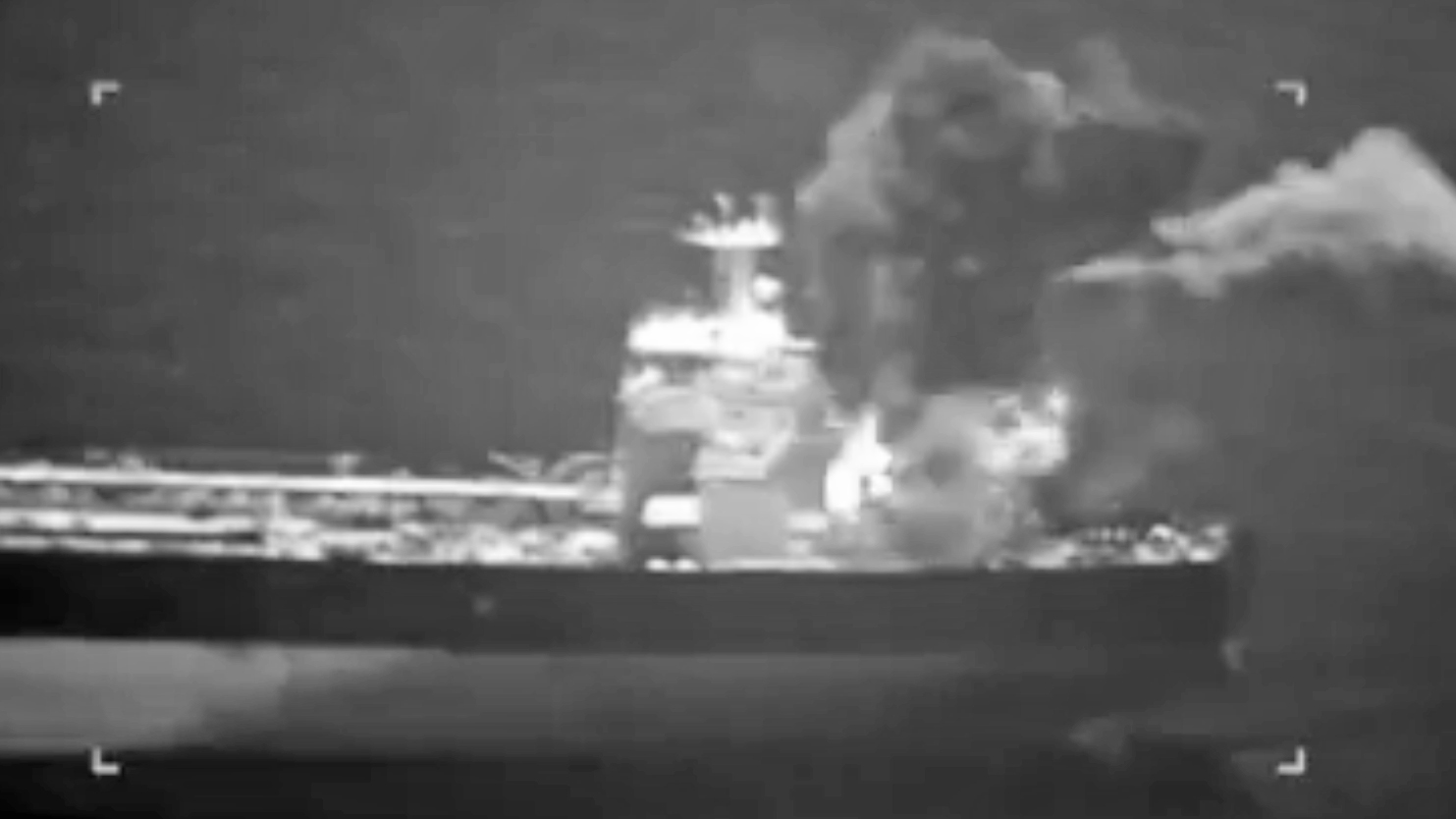
F/A-18 Super Hornet Drops Bombs Down Smoke Stacks Of Iranian Tankers Running Blockade
The U.S. carried out new attacks on Iranian targets today, striking several empty oil tankers trying to break the blockade, according to a post on X by U.S. Central Command (CENTCOM). This latest incident comes as the UAE says it was attacked again by Iran today and hours after the U.S. and Iran exchanged blows in and around the Strait of Hormuz.
U.S. forces “disabled M/T Sea Star III and M/T Sevda, May 8, prior to both vessels entering an Iranian port on the Gulf of Oman in violation of the ongoing U.S. blockade, CENTCOM stated. “A U.S. Navy F/A-18 Super Hornet from USS George H.W. Bush (CVN 77) disabled both tankers after firing precision munitions into their smokestacks, preventing the non-compliant ships from entering Iran.”
This was the third time that the U.S. has fired on Iranian ships running the blockade. The Navy has used a destroyer’s five-inch gun firing inert rounds to blast the engineering section of one ship to disable it and a Super Hornet’s 20mm Vulcan cannon to disable the rudder on another. So, the use of bombs dropped down a ship’s smokestack to disable but not destroy a ship is new. You can read about these prior instances here.
The weapons used in this latest wave of attacks on blockade runners wasn’t disclosed. 500lb laser-guided bombs are likely what was employed here based on the Super Hornet’s stores options, precision required, and the effects seen. These can utilize high-explosive bomb bodies or inert ones for desired effects, with the latter being most probable in this case.
Fox News reporter Jennifer Griffin was the first to report this news.
The blockade on Iranian ports was enforced April 13 to strangle Iran’s economy as part of U.S. President Donald Trump’s efforts to prevent Iran from obtaining nuclear weapons. On Friday, CENTCOM reported that U.S. forces have prevented more than 70 tankers from entering or leaving Iranian ports.
“These commercial ships have the capacity to transport over 166 million barrels of Iranian oil worth an estimated $13 billion-plus,” the command stated on X.
However, “a confidential CIA analysis delivered to administration policymakers this week concludes that Iran can survive the U.S. naval blockade for at least three to four months before facing more severe economic hardship,” The Washington Post reported on Thursday, citing four people familiar with the document.
Meanwhile, the United Arab Emirates claims it was once again attacked by Iranian ballistic missiles and drones on Friday.
“The Ministry of Defense announced that on May 8, 2026, the UAE air defense systems engaged 2 ballistic missiles and 3 UAV’s launched from Iran, resulting in 3 moderate injuries,” the UAE Defense Ministry (MoD) announced on X Friday morning EDT. “Since the beginning of the blatant Iranian attacks on the United Arab Emirates, the air defenses have engaged a total of 551 ballistic missiles, 29 cruise missiles, and 2,263 UAV’s.”
The UAE, located about 60 miles south of Iran across the Strait, claims these attacks have killed 13 and injured 230.
The MoD “affirmed that it remains fully prepared and ready to deal with any threats and will firmly confront anything that aims to undermine the security of the country, in a manner that ensures the protection of its sovereignty, security and stability and safeguards its interests and national capabilities.”
Tehran did not immediately respond to the claim, which TWZ cannot independently verify.
These incidents follow an exchange of fire last night between the U.S. and Iran. As we reported yesterday, U.S. Central Command said it attacked several locations in Iran after “Iranian forces launched multiple missiles, drones and small boats as USS Truxtun (DDG 103), USS Rafael Peralta (DDG 115), and USS Mason (DDG 87) transited the international sea passage. No U.S. assets were struck.”
Iran said it launched the attacks in retaliation for “violation of the ceasefire and the aggression by the terrorist US military against an Iranian oil tanker near the port of Jask.”
The extent of the damage to Bandar Abbas, Qeshm Island and the Bandar Kargan naval checkpoint in Minab, targets struck by the U.S. on Thursday in response to the attacks on U.S. Navy ships, remains unclear. No images have emerged and neither Iran nor the U.S. have commented.
Last night, Trump called the exchange a “love tap” and said the ceasefire still held.
This is a developing story.
Contact the author: howard@twz.com
editor's pick
latest video

news via inbox
Nulla turp dis cursus. Integer liberos euismod pretium faucibua