This post was originally published on this site.
Nigeria Exclusive: Ending the Violence, One Soul at a Time
This post was originally published on this site.

“The Fulani are obsessed with their cows. They love their cows more than human beings,” said Gabriel, a local security agent protecting Christian pastors and missionaries.
The Fulani Muslims are responsible for much of the killing and kidnapping of Christians in Nigeria’s Middle Belt region. This region lies along the divide between the Christian south and the Muslim north, and the Fulani are primarily herders.
Often, attacks are triggered when Fulani herders drive their cattle into Christian farms, where they eat or destroy crops. When Christians object, they are met with violence, with entire villages destroyed and unarmed Christians raped, murdered, or kidnapped.
Gabriel explained that the Fulani, who are actually a minority, are well organized and able to call large numbers of well-armed fighters together from great distances. They sometimes use social media, but most of their communication is done through runners.
“They send guys on motorcycles who give verbal messages to coordinate attacks and movements,” added Anthony, with Palace Alliance, a U.S. NGO coming to the aid of Nigerian Christians.
As Christians cannot own weapons and do not have their own militia for protection, some in the community have tried to end the violence one soul at a time by reaching out to the Fulani and sharing the love of Christ.
For the Fulani, however, converting to Christianity comes with a tremendous cost. They are ostracized from their community, can no longer herd cattle, and face severe persecution. In the worst cases, they become targets for assassination.
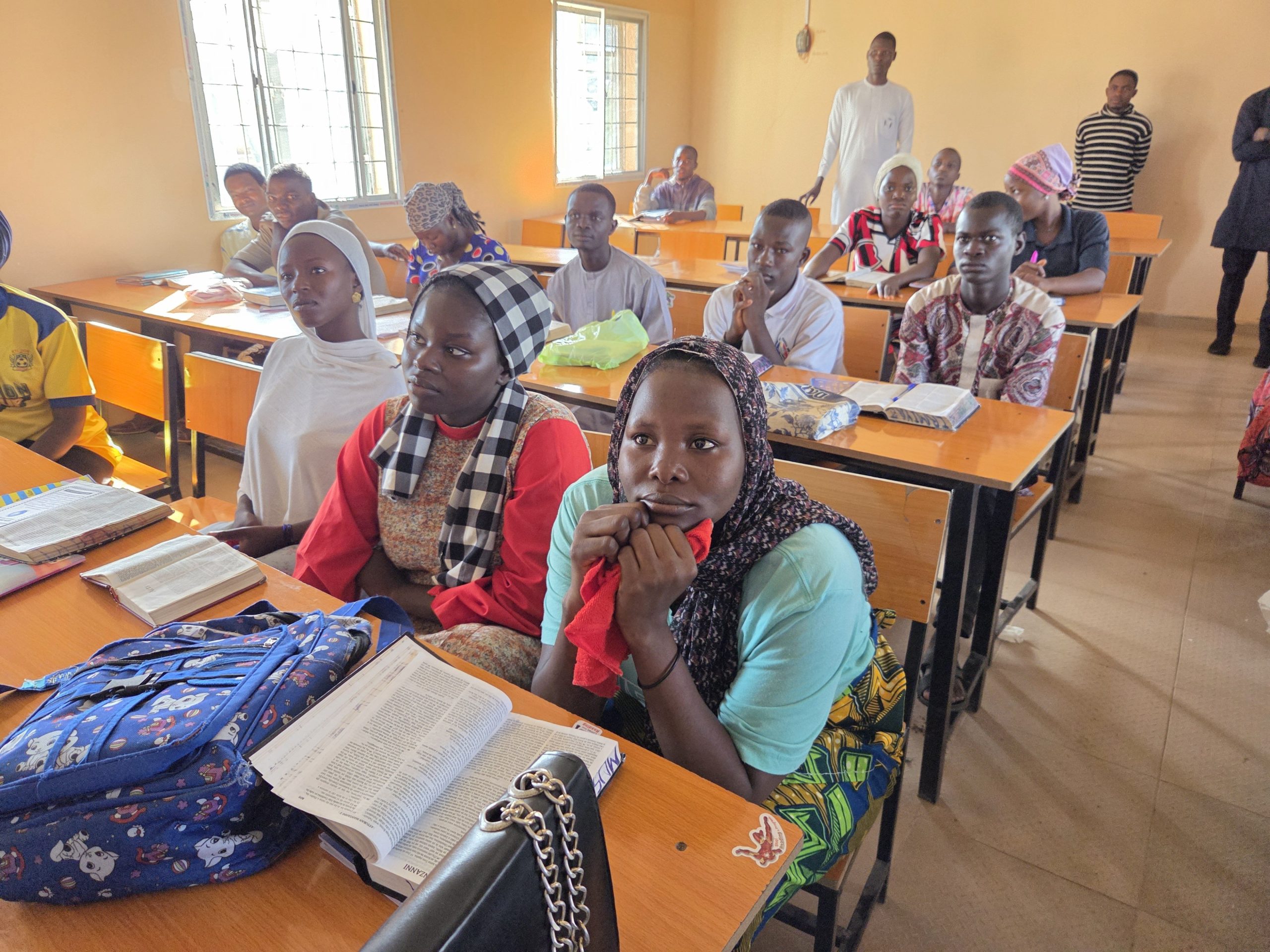
In a walled community just outside Jos, a city on the frontline, sits Harvest Training Center, a project overseen by a local Christian organization, City Ministries of EMS/ECWA. The center provides discipleship training to Muslim converts to Christianity, preparing them to return to their communities and share their faith in the hope of reducing the violence.
training, students live in the center, where they receive meals and lodging and live in a safe environment, protected from Islamist reprisals.
In one of the classrooms, a kindly teacher, Garba Zambu, was teaching a lesson from the Acts of the Apostles as he prepared the students to eventually leave the center and spread the Word.

“Mostly, the students come from the northern part of the country, from different tribes,” he said. While all tribes are welcome, he explained that “principally, we focus on the Fulani.” He went on to say that many Fulani had already graduated from the program and that some had even become pastors.
One of the graduates who is now a pastor teaching in the program was named Mohammad. Finding a Christian who bears the name of the Islamic prophet is a testament to how this ministry is impacting the world around them.
In order to recruit students for the program and build relationships between the Christian and Muslim communities, City Ministries sends missionaries to provide free veterinary assistance to the Fulani. Others help dig wells so they can water their cattle. Through service and love, they hope to plant seeds that will generate interest in learning more about Christianity. At the very least, it helps build understanding and friendships, making it less likely that the Fulani will kill their Christian neighbors.
Because the converts can never return to their previous life of herding, the center also provides job-skills training, including sewing, hair cutting, shoe making, and computers. Unfortunately, there is a shortage of both computers and electricity.
“We don’t have a source of light, electricity. We are living on solar here, and we cannot be able to turn on the computers,” said Zambu.
Apparently, there was some form of municipal electricity, but it stopped three kilometers short of the training center. Zambu added, “So, we are looking for when God will help us.”
Joel Haruna, who coordinates outreach for City Ministries, said they would like to expand the program to allow more students in, but they are limited by the number of classrooms and dormitories available. “We are putting everything that we do into the hands of God,” he said, as they pray for more support to come in.
After graduation, Haruna said, “they become new people. So, to a certain degree, it reduces those who are part of the violence, and they become like missionaries to their people.” Zambu added, “And they try to bring others out of banditry and some of this.”
Students are given a set of tools to set up their own small business. According to Haruna, this income generation is a crucial component of the program. “After they leave, they don’t have any place to go because their families were rejecting them.”
However, thanks to the program, they return with the skills they have learned, and “some have even become the breadwinners of their families. And they’re reaching out to their families and bringing many out of Islam.” Zambu added that they are not only bringing their communities out of Islam but also out of banditry and violence.
Approximately 60 students have graduated from the program so far. “Those 60 who are out there in the community have their own businesses, and they’re doing well,” Haruna said.
A pastor from Palace Ministries closed the visit by encouraging the students with a reading from Mark 10:29: “No one who has left home or brothers or sisters or mother or father or children or fields for me and the gospel will fail to receive a hundred times as much in this present age.”
Haruna said, “They’ve passed through terrible experiences. Some face rejection from their families, but coming here, they find a new family again.”

The post Nigeria Exclusive: Ending the Violence, One Soul at a Time appeared first on The Gateway Pundit.
editor's pick
latest video

news via inbox
Nulla turp dis cursus. Integer liberos euismod pretium faucibua
Leave A Comment
You must be logged in to post a comment.