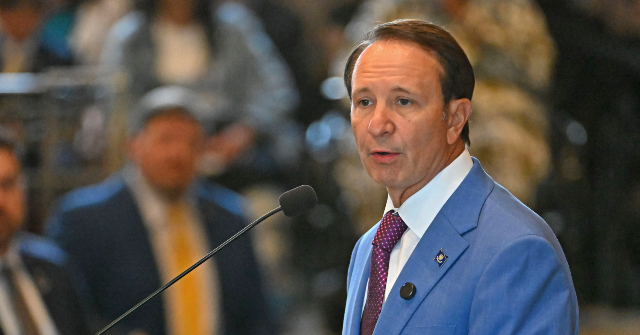
Louisiana Gov. Jeff Landry to Redraw Congressional Districts After Supreme Court Ruling
Louisiana Gov. Jeff Landry said on Wednesday that he plans to suspend May’s primary elections to allow state lawmakers to draw a new congressional map for the state after a Supreme Court ruling struck down race-based redistricting in the state.
Landry told House Republican candidates on Wednesday that he will cancel the May 16 primary elections, and the formal announcement could come as early as Friday.
The Louisiana governor’s reported move follows as the Supreme Court ruled that a black-majority district in the state violated the Constitution. The Supreme Court ruling gutted a key part of the Voting Rights Act.
The conservative majority at the court ruled that the race-based congressional district amounts to an “unconstitutional gerrymander.”
The ruling at the nation’s highest court could spur other Republican-led states to redraw congressional maps to boost the GOP’s chances of keeping the House majority.
“Section 2 of the Voting Rights Act of 1965 was designed to enforce the Constitution — not collide with it. Unfortunately, lower courts have sometimes applied this Court’s §2 precedents in a way that forces States to engage in the very race-based discrimination that the Constitution forbids,” Justice Alito wrote for the majority.
“This tension between §2 and the Constitution came to a head when Louisiana redrew its congressional districts after the 2020 census. In 2022, a federal judge in the Middle District of Louisiana held that the map adopted by the state legislature likely violated §2 because it did not include an additional majority-black district,” he continued.
“But when the State drew a new map that contained such a district, its new map was challenged as a racial gerrymander. A three-judge court in the Western District of Louisiana held that the new map violated the Equal Protection Clause, and the State appealed to this Court.”
“For over 30 years, we have assumed for the sake of argument that the answer is yes. And we have gone further and assumed that it is enough if a State ‘ha[s] a strong basis in evidence’ for thinking that the Voting Rights Act requires race-based conduct,” Alito wrote.
He added, “But allowing race to play any part in government decision-making represents a departure from the constitutional rule that applies in almost every other context. These and other problems convinced us that the time had come to resolve whether compliance with the Voting Rights Act can indeed provide a compelling reason for race-based districting.”
editor's pick
latest video

news via inbox
Nulla turp dis cursus. Integer liberos euismod pretium faucibua